VALORANT Ban Numbers: 677,000 Accounts in 44 Days, and Cheaters Were Not the Biggest Group
Riot banned 677,000 VALORANT accounts in 44 days and published the breakdown for the first time. The headline number is cheaters. The real story is the category that beat them by 68 percent.
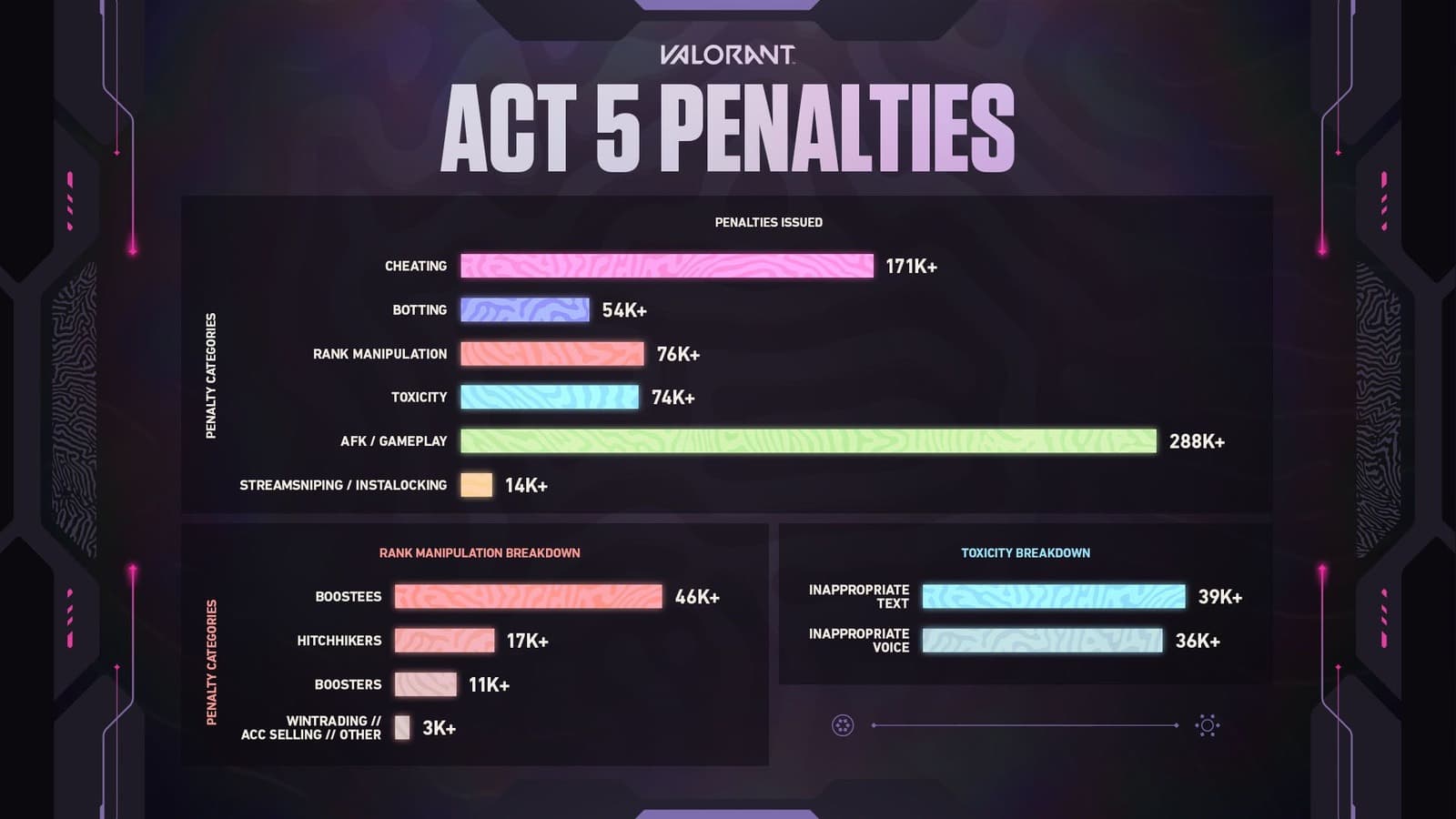
AFK and gameplay abuse accounts for 288,000 bans, well ahead of cheating (Image: Riot Games)
Riot banned roughly 677,000 VALORANT accounts between August 18 and October 1. That is 44 days. Work it out per hour and you get about 640 accounts, around the clock, for six and a half weeks.
The VALORANT ban numbers arrived inside the Patch 13.08 notes, and Riot says it plans to publish them regularly from now on. Most coverage will lead with the cheaters. The cheaters are not the biggest group.
What do the VALORANT ban numbers actually show?
Riot broke Act 5 into six categories. Here they are, largest first.
AFK and gameplay abuse: 288,000 accounts, 43% of the total
Cheating: 171,000 accounts, 25%
Rank manipulation: 76,000 accounts, covering boosters, boostees, hitchhikers and wintraders
Toxicity and comms abuse: 74,000 accounts
Botting: 54,000 accounts
Streamsniping and instalocking tools: 14,000 accounts
AFK and gameplay abuse beats cheating by 68 percent. It is bigger than rank manipulation, toxicity and botting put together. If you have ever lost a ranked game because somebody walked into spawn and stopped moving, that category is the one you have met.
The caveat that most coverage will skip
Read Riot’s wording closely. These are accounts “fully banned from playing VALORANT for three days or longer.”
Three days or longer is a wide net. A permanent cheating ban counts once. A 72-hour AFK suspension counts once. They sit in the same table looking like equivalent events, and they are not.
That almost certainly inflates the AFK figure relative to the others. Leaving games gets you a short suspension that escalates with repeat offences, so one player can appear in that column several times across an Act. Cheating usually ends the account on the first detection.
So the honest version is narrower than the headline. VALORANT does not punish AFK players harder than cheaters. It punishes far more of them, far more often, with far lighter consequences.
Why does the AFK number matter?
Because it tells you what is actually degrading your games.
Cheating dominates the conversation. It is the thing people clip, the thing that gets threads to the front page, the thing Vanguard exists to stop. And 171,000 accounts in six weeks is not a small number.
But the thing more likely to ruin your evening is somebody on your own team deciding, four rounds in, that they are done. Riot’s own data puts that at nearly three hundred thousand punishable cases in a month and a half, and those are only the ones that crossed the three-day threshold. Shorter suspensions and queue restrictions are not in this table at all.
Impossible to say from one set of VALORANT ban numbers, and that is the frustrating part of a transparency report with no history behind it.
171,000 cheating bans could mean detection improved. It could mean cheating grew. Without the same figure for Act 4, or Act 3, the number has nothing to be measured against. Riot has promised more frequent reporting, which fixes this problem in about two Acts.
The 14,000 banned for streamsniping and instalocking tools is the line worth watching. It is the smallest category by some distance. It is also the newest kind of enforcement, which points to young detection tooling rather than rare behaviour.
What else is in VALORANT Patch 13.08?
The ban report shares a patch with the start of V26 Act 6 and a genuinely busy set of competitive changes.
Map Rating is the headline feature. Every map now gets a personal score from 0 to 500 and a letter grade from C to S. Four stats feed it: overall win rate, attacker win rate, defender win rate and Performance Score.
Recent games count for more than old ones, so a bad month on Haven is recoverable. Nobody else can see your rating, everybody starts from zero at launch regardless of history, and it only tracks Competitive and Premier. You will find it in Agent Select, the end of game screen and a new navigation bar in Career.
Corrode gets its first real rework, a year after release. Defender spawn paths into the back of A and B have been shortened, because rotations were taking long enough to make retakes close to impossible.
Mid got the bigger change. The half wall is now metal and sits a metre further out, which cuts down on wall spam and lets attackers slip into A Link unseen from Top Mid. The boxes at the back of Lower Mid have moved toward B with a jump-up added. The A site plant zone has also been adjusted to weaken post-plant positions from A Link.
The map pool rotates. Bind and Corrode come into Competitive and Deathmatch. Ascent and Split go out, which confirms the map pool rotation we reported last week.
Bind and Corrode are in, Ascent and Split are out (Image: Riot Games)
Performance Score was quietly adjusted back in 13.06. Riot says damage, adjusted kills and adjusted deaths now carry more weight, with specific changes for Chamber to better reflect his utility.
Will the ban numbers keep coming?
Riot says yes. The stated plan is to publish VALORANT ban numbers “more often” as part of a wider push on transparency, and the Act 5 table is the first instalment.
That matters more than the numbers themselves. A single snapshot is interesting. A quarterly series tells you whether Vanguard is gaining ground on cheat developers or losing it, and whether the AFK problem is growing with the player base or outpacing it.
What should you do with this?
Report people. That is the unglamorous answer and Riot asked for it directly in the notes, saying reports feed the detection tooling rather than just the punishment queue.
It is easy to assume reporting an AFK does nothing because the game is already lost. The 288,000 number suggests otherwise. That column does not fill itself.
Full notes are on the official VALORANT site. We cover every patch in our VALORANT section. Our full ranked guide explains where Map Rating sits alongside your actual rank.



 VALORANT
