VALORANT Map Rating Explained: What the 0 to 500 Score Actually Measures
Patch 13.08 added a private score for every map you play. It is not a rank, nobody else can see it, and the most useful number in it is the one people will ignore.
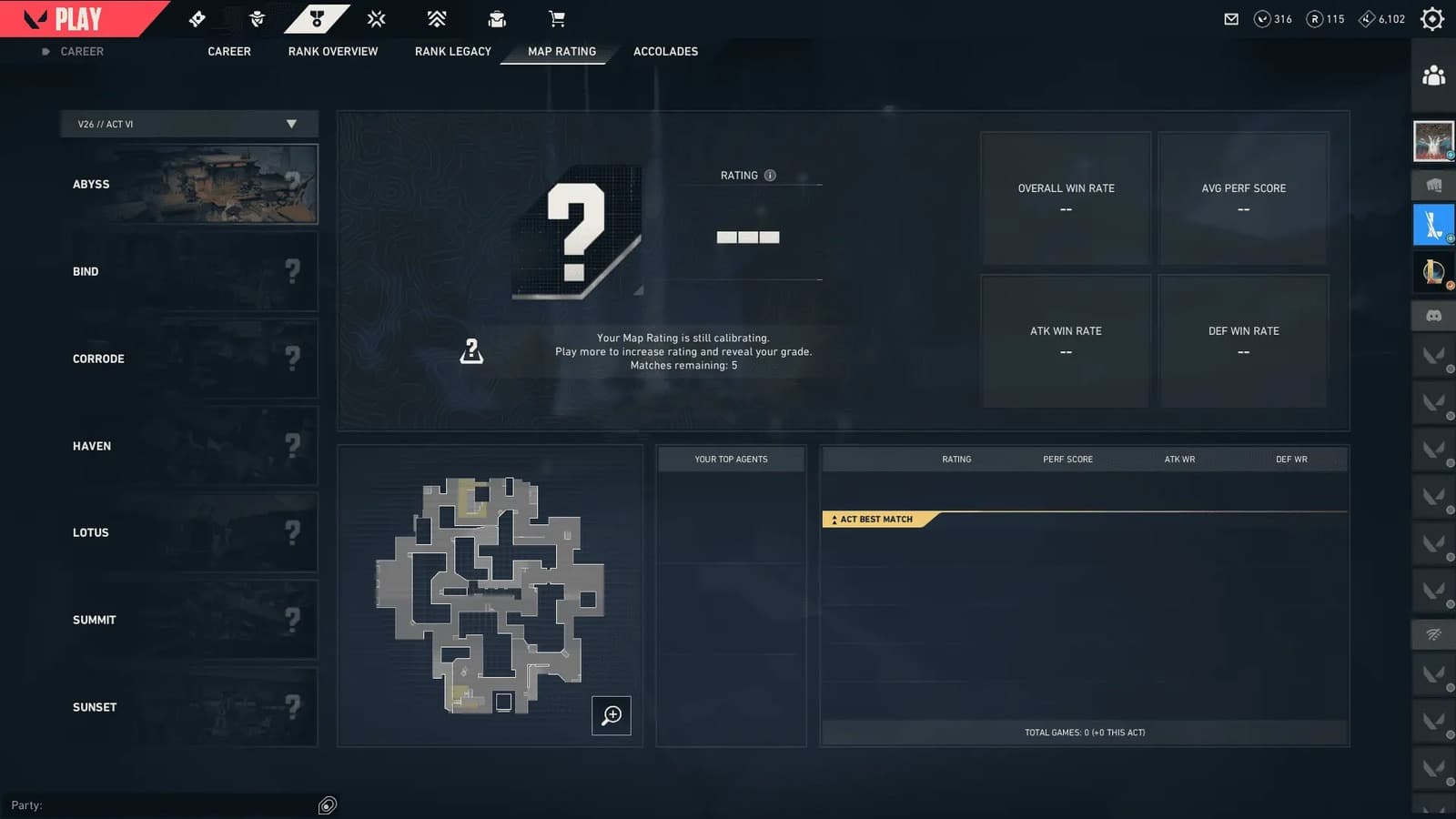
Map Rating lives in a new Career tab and calibrates over five matches (Image: Riot Games)
Patch 13.08 quietly handed every VALORANT player a report card for each map, and most people will misread it within a week.
VALORANT Map Rating is not a second rank. It does not move your RR. Nobody else can see it, so a bad grade on Lotus follows you into Agent Select and nobody else. What it does give you is an answer to a question the game has never answered. Are you actually good on this map, or do you just like it?
What is VALORANT Map Rating?
Every map you play in Competitive or Premier now carries a personal score from 0 to 500. On top of that sits a letter grade running from C up to S.
The VALORANT Map Rating grades are finer than the four letters suggest. C, B and A each hold three steps, marked by pips on the badge, which gives you nine rungs before S. S itself has no sub-levels. Ten grades in total, not four.
The score moves as you play. Recent matches count for more than old ones, so a rough patch is recoverable. A good month three seasons ago is also no longer propping you up. Everyone started from nothing when the feature launched, because Riot is not backfilling historical match data into it.
You will find it in three places. Agent Select, the end of game screen, and a new navigation bar in Career that also holds Rank Overview, Rank Legacy and Accolades.
The Career tab is the detailed one. It lists every map in the current pool down the left side, and selecting one gives you the four stats as separate boxes, a minimap, your top agents on that map, and a per-match table showing rating, Performance Score, attacker win rate and defender win rate for each game. Your best game of the Act gets flagged in that list.
The four stats that feed it
Riot named the inputs plainly.
Overall win rate: how often you win on that map, full stop
Attacker win rate: your round win rate on the attacking side
Defender win rate: the same on defence
Performance Score: VALORANT’s own per-match rating of your contribution
Improving any one of them raises your rating. That is as specific as Riot got.
What Riot has not told anyone
Two gaps are worth knowing about before you start theorising on Reddit.
The weighting is unpublished. Riot has not said whether Performance Score counts for a quarter of the rating or half. Anyone telling you the exact formula this week is guessing.
The grade thresholds are unpublished too. We know the scale runs 0 to 500 and the grades run C to S. We do not know whether S starts at 400, 450 or somewhere else, and nothing in the patch notes pins it down.
The calibration period is the one gap the client fills in for you. Before a grade appears, the Map Rating tab shows a counter reading “Matches remaining: 5” alongside the line “Your Map Rating is still calibrating.” So five games per map, and your score stays hidden until you play them.
How do you raise your VALORANT Map Rating?
Here is where the same patch notes become genuinely useful, because Performance Score is the one input Riot has documented.
Patch 13.06 increased the score impact of damage, adjusted kills and adjusted deaths. Those adjusted metrics explicitly include first bloods and first deaths, which means the opening duel carries real weight in both directions.
So the practical version. Take the opening fight when it is good. Avoid dying first when it is not, and keep doing damage even in rounds you lose. Chip damage that sets up a teammate’s trade is counted, which is the entire reason Performance Score exists rather than Riot just using ACS.
C, B and A each hold three steps. S does not (Image: Riot Games)
Riot also made Chamber-specific adjustments so his utility use reads more accurately. Expect more agent-specific tuning as the system matures.
The number most people will ignore
Overall win rate is the stat everyone will stare at. The split between attacker and defender win rate is the one that actually tells you something.
Think about what that comparison reveals. If you sit at 40% on attack and 60% on defence on Bind, you do not have a Bind problem. You have an attacking problem on Bind. That is fixable: entry timings, utility on the way into site, your default setups.
Before this, working that out meant a tracker site or trawling your own match history by hand. Now it is in Agent Select, next to the map you are about to load into.
Our full ranked guide covers how RR and rank actually work, which Map Rating sits alongside rather than replacing.
Ratings are split by Act
The Career tab opens on a dropdown reading V26 Act VI, which means Map Rating is tracked per Act rather than as one running total. The per-match table also separates total games from games this Act.
Riot has not spelled out what carries over when an Act ends. The dropdown implies past Acts stay viewable, but whether your rating resets or continues into Act 7 is not something the patch notes answer.
Does Map Rating affect your rank?
No. It is a measurement, not a mechanic.
Your rank still moves on wins, losses and RR exactly as it did before. Map Rating reads the same matches and reports back on them. A player stuck in Gold with an S on Ascent is still in Gold.
Nobody else sees your rating either. Riot was explicit about that, which rules out the obvious worry about teammates flaming you in Agent Select for a C on Haven.
Which maps does it cover?
Map Rating tracks Competitive and Premier only. Unrated, Swiftplay, Deathmatch and the rest do not feed it.
VALORANT Map Rating currently lists seven maps: Abyss, Bind, Corrode, Haven, Lotus, Summit and Sunset. Ascent and Split are absent, which matches their removal from the Competitive queue in this patch.
That matters more than it sounds, because the competitive map pool rotates. Patch 13.08 brought Bind and Corrode into Competitive and Deathmatch while Ascent and Split went out, which we covered in our map pool breakdown.
Riot has not said what happens to a rating on a map that leaves the pool. The sensible assumption is that it freezes and waits, since recency weighting has nothing new to weigh. But that is an assumption, not a confirmed rule.
Is Map Rating worth paying attention to?
For most players, mildly. For anyone who actually wants to climb, yes.
The honest limitation is that it tells you what is happening without telling you why. A C on Fracture is a diagnosis, not a treatment plan. You still have to open your own VODs and work out what went wrong.
But a private, per-map, side-split performance number that updates as you play is a real tool, and it is free. Riot shipped it in the same patch where it published its Act 5 ban figures, which makes 13.08 an unusually transparent update by VALORANT’s standards.



 VALORANT
