

 VALORANT
How to Activate Riot Mobile MFA For VALORANT: 2026 Guide
Here’s how to activate Riot Mobile MFA for your VALORANT account in 2026, so you can get back to playing Ranked.
4 Oct 20262 min
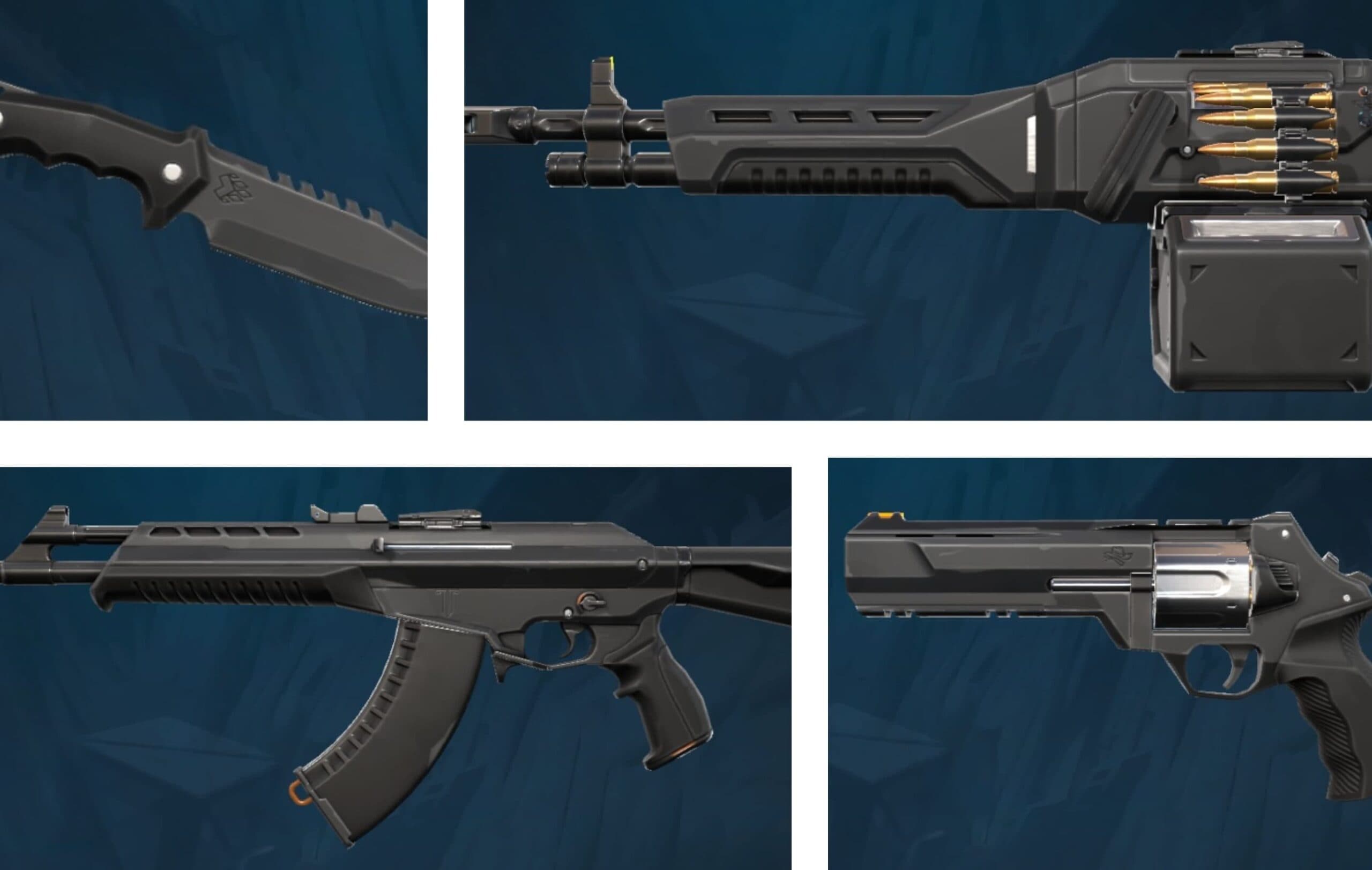
Every VALORANT weapon has its time and place. Image Credits: Riot Games
FPS games always rely on aim, but it’s also important to pick the best VALORANT weapon. Let’s explore how to use all of the game’s guns, when to buy them, and some tips to help you diff your opponents.
During the Buy phase of each VALORANT round, you can see a little indicator of your minimum credits next round on the bottom right of the screen. For a healthy eco, you should aim to keep this number above 4,000.
Your teammates will probably make calls for what guns to buy. Here’s what they mean:
Your first rounds on each half should always be pretty minimal buys. You want to prioritize your utility here, and it generally isn’t worth it to grab guns that aren’t pistols for that reason. If you win that round, you should always force on the 2nd round of the half. Typically, this means buying a mid-level gun like a Spectre, Stinger, or Marshal. If you win that round, too, you keep the mid-level gun next round instead of buying a better weapon. This is called a Bonus. If you lose, you go straight to buying Vandal and Phantom.

So, to sum it up:
You can access the VALORANT Buy Menu by pressing B at the beginning of a match.
In some scenarios, there are exceptions. Some teams have enough confidence to buy above-budget guns in Round 2 after losing the pistol round. This is called a Reverse Force. It can catch enemies unaware at times, but if you lose, you are almost guaranteed to lose another round since you won’t have enough money to force in sync with the enemy.
Also, if most of your team is forcing up despite being above budget, you should probably force up too, since it’s better to keep buys in sync. This only applies if 3/5 or more of your teammates are buying, since sometimes teams will buy a single player a weapon and try to chain kills/get more guns off of that.
Now, let’s walk through every gun, their strengths and weaknesses, and when to use them. Right off the bat: If there’s a specific weapon you want to skip to, just head to the Table of Contents on the right side of the page.

The Classic is the most versatile VALORANT weapon. You can use this close-range, long-range, whatever. It has consistently decent accuracy, nothing to write home about, but it gets the job done.
The Classic is most notable for two things: its completely free cost and its right-click ability. If your teammates call for a ‘full save’, don’t buy anything and just use this. The Classic’s primary fire is a normal pistol, but its secondary right-click gives it a shotgun-like spray that can easily kill close-range enemies.
Another important thing to note is that you can always switch over to the Classic or any other pistol when you run out of bullets. This can win some important fights. You can also use Classic and other Pistol shots to buy time, bait out opponents who think you’re on bad eco, or destroy utility you don’t want to waste top-tier weapons on (think Deadlock and Sage walls).

The Ghost has a much higher accuracy than other pistol options, so it’s one of the more popular eco buys. It is silenced from far distances, so enemies won’t hear the audio cues of you shooting. It also hides its tracers, so it’s great to spam through smokes on eco rounds.
This weapon is deadly in the right hands and quite versatile, but the Sheriff and Bandit pack a better punch for headshots.

The Bandit can kill enemies with Light armor in one headshot at close range. At long range, it still kills enemies with no armor, but you’ll need to two-tap anyone who bought. It’s kind of the middle ground between the Ghost and the Sheriff. You can still spam it, but it has less spam accuracy than the Ghost, and it’s not as effective across the map as the Sherriff.

The Shorty is a very situational gun. It’s usually better if you’re holding a rat corner on the Defender half, and it can be very hard to push angles and take map space with. It’s highly inaccurate and best for scenarios where the enemy will quickly swing right in front of you.
This VALORANT weapon is useful in a very specific Agent pool. Some Jett players like it because they enjoy long-range snipers, and can quickly swap to it to down unexpected close-range opponents. Jett’s Tailwind dash also lets her close distance quickly, so she can jump into melee range with the Shorty quickly. Raze can also grab it for this reason. Yoru players use it during their Ult and Teleports, since this also lets them close distance fast. The Shorty is also great in Viper Ultimates, since the Ult wears enemy HP down as they travel in it. Once players reach the center, a Shorty can kill them in one shot, and it’s extremely cost-efficient at just 300 creds.

The Frenzy’s fire rate is insanely fast, so it’s great for spamming while running it down. That said, it also has a decently accurate first shot. Players usually opt for this on close-range sites or maps (for example, Bind). However, it has a very small mag, so you may run out of bullets quickly.

The Sheriff is so good it can count as a half-buy weapon. It can one-shot opponents from a long range, but it has a longer reload time than the Bandit and isn’t easy to spam. This is also the only high-pen pistol, meaning it can kill opponents through most walls.
Your movement needs to be clean to use this VALORANT weapon effectively, since it relies on high accuracy. You should practice strafing, counter-strafing, and stopping completely before shooting. It’s great to play Deathmatch to improve.

The Stinger is the VALORANT weapon for players on the move. It can alternate between a precise, single-bullet primary fire and a burst fire mode. This is decent for half-buy rounds, but it is not the gun you want to quick against long-range opponents. You will run out of bullets quickly, and the recoil is too severe to carefully poke in and out of fights.

The Spectre is one of the best guns for spamming. It has a large bullet count. The best part is, it has no tracers, so you can feel completely safe shooting through smokes.
This is probably the one of the most popular VALORANT weapons for half-buys and bonus rounds. It’s versatile, has a relatively high accuracy, and packs decent damage. This is best for mid-range fights, and though it will take a couple shots to down opponents at a distance, it easily headshots in closer corners. The Spectre can also dip in and out of longer fights, so you won’t get diffed if you mess up your initial engagement.

The bucky is a pretty cheap shotgun option. It has two modes: Primary Fire (left click) and Secondary Fire (right click). You want to use the Bucky’s left click for enemies who are closer to you, while saving the right click for mid-range fights.
The Bucky is extremely inaccurate and will not hold up well against opponents with long-range guns due to damage falloff. However, it is part of the best VALORANT weapon class for holding rat corners. You want to crouch behind a box, jump out from a corner, or hold a close-range angle flush to a wall inside a choke point.

The Judge is basically just the Bucky but better (controversial statement, I know). It doesn’t have a mid-range firing option, but has a much faster cooldown, meaning skilled users can wipe out an entire push super quickly.
The Judge and Bucky are most popular with Controller / Smokes Agents. This is because they can actually sit inside smokes with the shotguns to get easy kills. Skilled Controllers manipulate their smokes to create close-range angles and manipulate duels for their VALORANT weapon advantage. If you want to improve at this, watch some of the best Controller player pros like Paper Rex f0rsaken and s0m. Cypher is also a great Agent to use this gun on; just pretend his Cages are smokes.
Some of the best Judge angles to hold include:

The Bulldog is another half-buy favorite. It does teeter towards the higher end of the cost scale. The Bulldog and the Guardian can both be acceptable buys if you want to sync with your teammates’ force, but can’t afford a better rifle. It is a Medium-pen weapon, so it can down opponents through some walls.
This VALORANT weapon has extreme accuracy for its class and price range. It can take long-range fights better than the Spectre, while remaining very effective in close quarters. It is great for headshots and sustaining gunfights. In a sense, you could say the Bulldog is the ‘Vandal’ of mid-level guns, while the Spectre is more of the ‘Phantom’ option.

The Guardian is particularly dangerous to long-range opponents, since it can one-shot headshot most enemies. It is also a Heavy-pen VALORANT weapon, which means it can wallbang opponents through surfaces other guns can’t reach.
However, you absolutely cannot spam with this gun, and it is difficult to sustain long-term gunfights with it. The Guardian needs to reload frequently, and its magazine size is very small. Typically, you’d want to take long angles with it. Think Ascent mid, or holding B long on Pearl.
You also NEED to aim train if you use the Guardian. It relies on hitting headshots most of the time, and if you miss your first shot, an experienced enemy will easily spray you down. Like Sheriff-only Deathmatch, a few Guardian-only rounds are your best friend here.

The Phantom and Vandal are the game’s two most iconic rifles. The Phantom is designed for players who want the best possible versatile VALORANT weapon at all ranges. It can easily alternate between spamming and precise shooting, and is great in both close quarters and far distances.
So, what’s the drawback? While the Phantom is always more consistent, it doesn’t have the first-shot accuracy or the damage of the Vandal. The gun you choose is really a question of how risk-tolerant your playstyle is. If you prioritize consistent impact or you’re having a bad aim day, the Phantom is probably better for you. This gun also has less movement error and recoil than the Vandal, so it’s good to consider if you’re on an Agent with heavy mobility, like Raze or Neon.
The Phantom also has no visual bullet tracers. This means it’s wise to consider if you’re going against a team comp with two or more Controller agents. If you have Sova on your team, you can wait for him to recon through a smoke and precisely kill enemies through it. It will be very difficult for them to trade you back.
There are two Agents who should heavily consider buying the Phantom every round: Cypher and Viper. By not revealing bullet tracers, Cypher can safely secure kills through his cages and eliminate key counterplay. A Phantom is also always better for Viper to use inside her Ultimate, just to be safe.

The Vandal is great for contesting long-range duels. It offers the one-shot Headshot kill power that the Phantom lacks, but is more inaccurate, has higher recoil, and has more movement error. If your aim and duel movement are strong enough, it can be a deadly game-changer, but think carefully before choosing it.
Once again, your Vandal accuracy heavily deteriorates after the first few bullets. Do not spam with this VALORANT weapon. In addition, be careful when shooting it through smokes, since you will leave tracers.
The Vandal will always remain meta because it has no damage falloff. The headshot kill potential remains the same at all ranges. The question is, can you hit that headshot?

The Warden is VALORANT’s newest weapon, and one of its three main Rifle options. This gun is best for players who want to contest long-range angles with high accuracy, since it has a 2x ADS scope. It also shares the long-distance damage benefits of the Vandal.
That said, the Warden is better for slower, calculated playstyles. It has the smallest magazine size of all three options, so you don’t want to waste your bullets. It also has a relatively slow firing rate. This isn’t the ideal weapon for entrying onto site, but you can still make some major impact fighting mid or keeping valuable space.
Sniper mains might also like this weapon, since it shares many of the same aim mechanics.

The Marshal is VALORANT’s cheapest Sniper, but it can have a good impact. It has a scope mechanic that lets players fire with zero error while not moving. The Marshal is a popular pick for Round 2 winners in a half, since it can easily kill players with no shields. Some users just opt for the Marshal to go for damage against opponents on a full save, since it is effective even with body shots.
It has a faster firing cooldown than other snipers, but it’s also more aim-dependent. It’s easier to get punished for missing the headshot here than on the Outlaw or Operator.
If you want to learn how to diff people with the Marshal, it would be a sin not to mention Kaemi. This streamer and YouTuber climbed to the game’s highest rank while only using this gun.

The Outlaw is more than twice the Marshal’s cost. However, it has a more consistent return. It’s also easier to use.
All Outlaw headshots will immediately kill the enemy they hit. In addition, body shots will immediately down opponents with light shields. Think of this as the ‘Operator Jr.’, for players who are still saving up for that sweet, sweet guaranteed one-tap.
The Outlaw invites counterplay with its extremely long reload. It also has only two bullets in its magazine. Players who use this gun need to constantly reposition and know when to dip out of duels if they go wrong. It’s easy to overwhelm them with a numbers advantage.

If you have ever played a single VALORANT game in your life, you will hear horror stories about the Operator. This weapon, inspired by Counter-Strike‘s infamous AWP, is a guaranteed one-shot one-kill. I’m here to tell you: relax. It’s not that scary.
All snipers have an extremely long reload time, so they have built-in counterplay. You just need to plan your pushes and play with your teammates better to win against them. If you are losing a game to an OP crutcher, you are:
I guarantee you, the Op’s reload time is longer than the wait for GTA 6. If you follow up on your teammate quick enough, they will still be polishing off the barrel while you pick them off.
That said, the Operator is extremely useful for making early impact in a game. It’s best for characters who can use movement abilities to quickly escape being traded. Jett, Yoru, and Chamber are all good choices. This also means you don’t typically want to use the Op in close range, since long-lasting duels are disadvantageous for you. Many Op players also pack a Shorty as their secondary for this reason. Ideally, you pick a long angle to camp, get a single kill, and immediately reposition without getting traded.
Some of the best long angles to hold with an Operator are:
You can use the Op as ‘stopper utility’ to deter teams from pushing a site. It is one of the best VALORANT weapons for the Defender side. However, the Operator is very bad for pushes, and sometimes it doesn’t make sense to use it for retakes or entries. Many well-meaning players pick up an Op from the enemy after successfully pushing a site, but stop to consider whether you and your teammates are actually comfortable with using the weapon before bringing it into the next round.
This is also the most expensive gun in the game at nearly 5,000 credits. Make sure you actually have enough to afford it. It might be worthwhile to just buy a teammate another Vandal instead.
If you want to get better at the Operator, you should watch some VALORANT pros. EDG ZmjjKK (KangKang), Aspas, Gen.G t3xture, and 100 Thieves Cryo are all solid options to learn from.

The Ares is a very situational VALORANT weapon. It has extremely low accuracy, but has a fast firing rate and does a ton of damage. This is the ‘Odin Jr.’ Notably, it becomes more accurate as you keep firing. The ideal way to use the Ares is to pick an angle, sit and crouch, open the sights, and just spam as enemies run into you.
The Ares is another gun that’s decently weak on the Attacker side. However, it can be a menace on Defender, especially since it is a High-pen weapon and can easily shoot through walls.

The Odin is another extremely expensive gun. It’s also a Defender-side menace. This Heavy-pen weapon can easily wallbang most locations on VALORANT’s maps. Sova and Cypher players like it for this reason. Ascent B Site and Split B Site are popular locations for these Agents to use it.
Odin users rely on camping an angle and spamming. Unlike the Ares, the Odin has a decently high initial accuracy. It also has two modes: Primary Fire lets players increase the fire rate over time while Secondary Fire keeps it consistent.
The Odin does an incredible amount of damage. However, it is difficult to move quickly with, and has an extremely long reload time. Players are vulnerable while equipping it and refilling its bullets.

The knife is essential to your VALORANT kit. You will always have one, and it never costs anything. However, there are a few important things to know about it:
Whew. That was incredibly long, so we won’t bore you with a lengthy outro. That said, we hope this guide helps you excel in your comp matches, and if you decide to use the Judge, please don’t queue at the same time as me.
Stay tuned for more VALORANT esports and in-game news.
VALORANTHere’s how to activate Riot Mobile MFA for your VALORANT account in 2026, so you can get back to playing Ranked.
 VALORANT
Here’s an up-to-date list explaining all VALORANT Ranked queue restrictions, based on party size, rank, and more.
 VALORANT
Here’s everything players need to know about VALORANT’s Ranked mode, including a list of all ranks and party restrictions.