

 VALORANT
Valorant Map Pool Leak: Corrode and Bind Return in 2026
Split and Ascent are leaving the Valorant map pool while Corrode and Bind return. See what changed and what to expect in ranked.
8 Oct 20262 min
ValorantboostingNew VALORANT boosting penalties will punish players who smurf to elevate teammates’ ranks. Here’s everything to know about the changes.
New VALORANT boosting penalties will punish players who misrepresent their ranks. Image Credits: Riot Games via Website
Smurfs beware: a new VALORANT update is cracking down on players who boost their teammates, and it can even reverse your rank and rewards. Let’s explore everything to know about the new VALORANT boosting penalties in Patch 13.01.
On July 14, 2026, Riot Games announced new, stricter penalties for players who boost VALORANT accounts. The studio stated, “We are rolling out a new detection today that allows us to precisely target boosters and related behavior. We rolled this out successfully in League of Legends last year, allowing us to separate normal play from coordinated abusive play.”
Riot Games clarified: “This is not about stopping people from playing with their friends. What we are targeting is a pattern of abuse that undermines competitive integrity. If you are playing the game normally and competing to win, queueing with friends remains completely fine.”
In addition, “As long as you are playing on your own, unshared account, and you haven’t intentionally tanked your rank to get into easier lobbies and are disrupting or manipulating ranks for your own or others’ gains, you are good to go.“
The punishments also span win-trading, where players coordinate to intentionally lose, and stream sniping, where players cheat by watching an enemy’s livestream.
These changes have already gone live. They are part of the Patch 13.01 update, which includes other significant in-game adjustments.

The studio defines boosting as “a type of smurfing [where] a player uses an account that is lower ranked than their own main account to inflate the rank of [other accounts].”
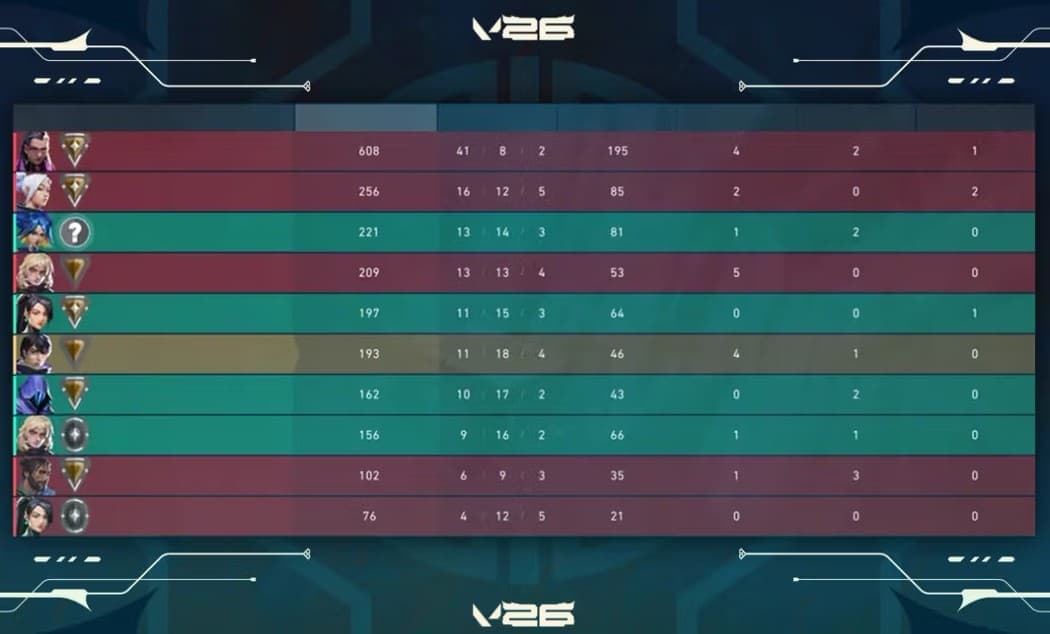
This is no foreign concept to frequent players: every gamer has seen the dreaded Jett/Sage duo, with one going 40/10 and the other holding zero kills. As it stands now, boosting is extremely common. It can be frustrating for the booster’s team, who have to deal with a poorly performing teammate, and the enemy team, who need to lock in against a player who clearly doesn’t belong in their rank.
VALORANT is cracking down on all players involved in the boosting process. There are three main scenarios where you’ll have to worry if you’re part of it:
So, even if you’re not directly boosting a teammate, VALORANT will still punish you for repeatedly queueing with them and benefiting from the scheme.
In an article release detailing the update, Riot Games elaborated on how it plans to enforce its anti-boosting measures. Notably, the penalties can actually reverse your rank if the boosting is severe enough.
Here’s a quick summary of what punishments players can expect:
VALORANT players can report a booster using the “Rank Manipulation” category. To do so, you just have to right-click on the user’s profile either mid-match or after the game. Then, click the ‘Report’ button and select ‘rank manipulation’ as the reason. Make sure to leave some feedback explaining why you think the player is smurfing.
Boosting, wintrading, and competitive integrity have been hot topics in the VALORANT community lately. Throughout the past two years, Tier 2 esports circuits have seen significant win-trading and rank manipulation allegations. Sean Gares, an FPS analyst and ex-pro with significant Counter-Strike experience, broached the first wave of allegations in May 2025. In as video titled “The Dark Side of Competitive VALORANT,” Gares claimed VALORANT Challengers teams were engaging in wintrading for money.
Just a year later, pro VALORANT coach and IGL Trick exposed a major alleged boosting ring. Trick’s claims were extremely similar to Gares’, as he noted several VCT Challengers pros allegedly participated in the scheme. Notably, Trick’s statements also alleged that a prominent VCT team was partially paying for its operations by selling boosts, and that one of the boosting ring’s members allegedly had industry connections that could determine which players got caught and banned. Well-known Cypher main and streamer Dasnerth also spoke out about boosting and the poor state of Ranked play.
Riot Games’ boosting crackdown arrived shortly after these revelations. Aside from just making ranked play frustrating, boosting at a high level has serious implications. VALORANT’s Challengers League (VCL) directly factors into the VCT through Ascension, meaning boosting at such a high level could influence the game’s most important tournaments if left unchecked.
Though Riot’s boosting changes haven’t directly referenced Trick or Gares’ statements, they seem to indicate the studio is taking community feedback to heart.
Stay tuned for more VALORANT esports and in-game news.
VALORANTSplit and Ascent are leaving the Valorant map pool while Corrode and Bind return. See what changed and what to expect in ranked.
 VALORANT
Team Vitality swept G2 Esports, and LOUD defeated NRG. Now, the two teams will meet in the VALORANT Champions 2026 Upper Bracket Finals.
 VALORANT
The new Razer Basilisk mouse has a perfect 180 spin button for FPS games and an AI button. Does it count as esports cheating?