Three big-name organizations. Three exits inside four months. One pattern impossible to ignore. Dota 2 organizations leaving the scene has gone from isolated incidents to a structural story in 2026. paiN Gaming pulled the plug in April. HEROIC followed on May 4. Tundra Esports walked away on June 1, transferring their entire roster to 1win Team. Each exit came with the same explanation, dressed up in slightly different language: the math no longer works.
This is not three coincidences. This is an ecosystem under stress. And it is happening at the exact moment the calendar should be at its most lucrative, with the Esports World Cup Paris on the horizon and TI 2026 in Shanghai eight weeks away.
What HEROIC said about Dota 2 organizations leaving
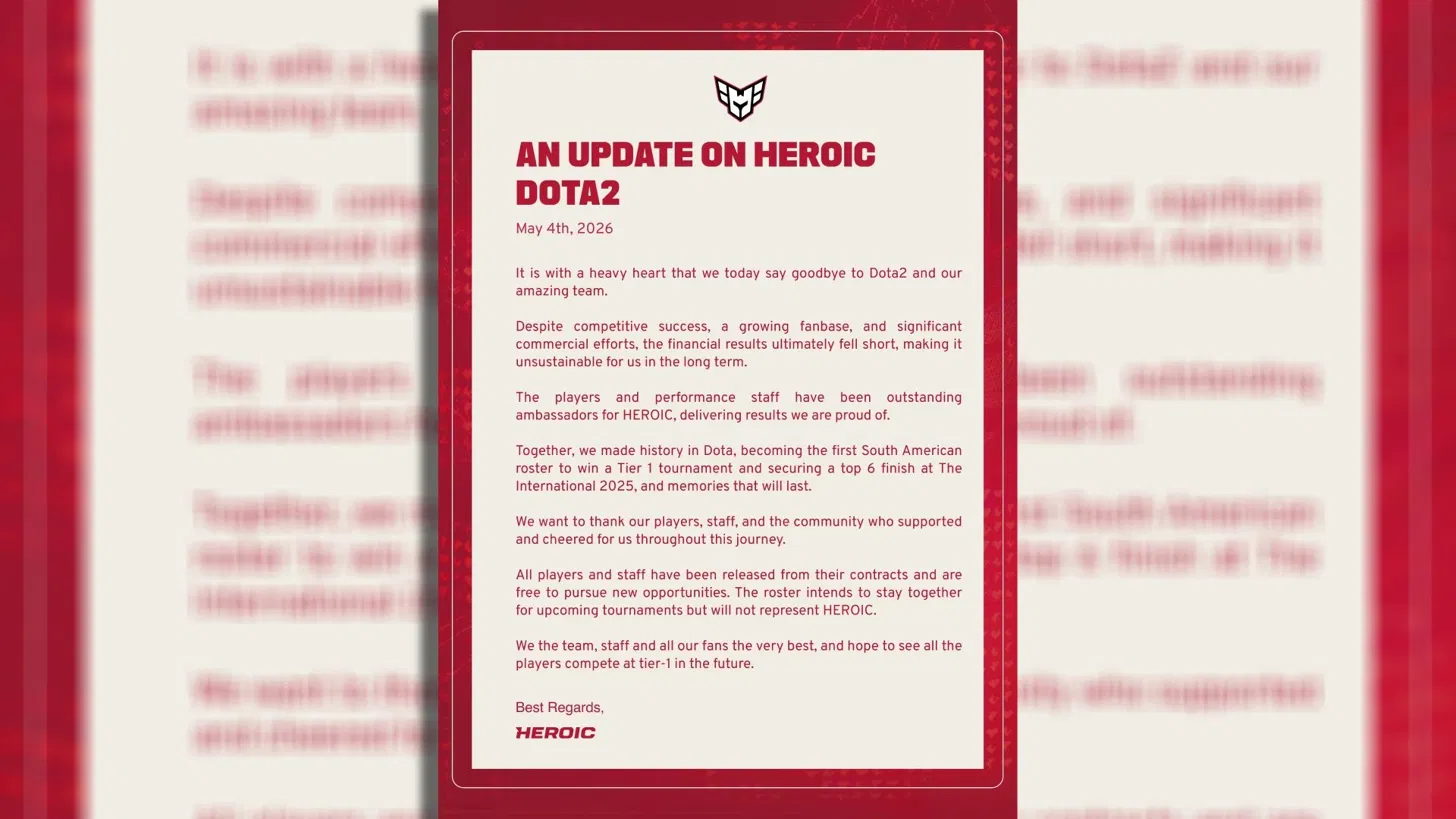
HEROIC’s statement on May 4 was direct. “Despite competitive success, a growing fanbase, and significant commercial efforts, the financial results ultimately fell short, making it unsustainable for us in the long term.” The Norwegian organization had spent two years building a South American roster that became one of the top teams in the region. They had earned around $1.4 million in prize money. They had a coach, Igor “kaffs” Estevão, who publicly confirmed the players “agreed as a group to stay together” after being released.
The HEROIC departure is the second wave of Dota 2 organizations leaving the scene in 2026. Their roster sat in 19th place on the ESL Pro Tour leaderboard when the announcement dropped. Twelve direct invite slots existed for the Esports World Cup 2026. As a result, HEROIC was looking at a near-miss on the most lucrative event of the back half of 2026. The commercial logic of paying tier 1 salaries for tier 2 prize pool access apparently did not pencil out.
HEROIC’s South American Dota 2 roster competing at PGL, the first South American lineup ever to win a Tier 1 Dota 2 tournament, per the organization’s farewell statement. Image: PGL
The HEROIC statement also said the right things publicly. Saying the right things, however, does not pay rent or salaries. Specifically, the gap between “strong competitive results” and “financial expectations” is exactly the gap that Dota 2 organizations leaving the scene have been quietly drowning in for years.
paiN Gaming’s earlier exit
paiN Gaming announced their departure on April 12, 2026, exactly two months after returning to Dota 2 in February. As a Brazilian organization, paiN had re-entered the scene with a Peruvian roster: Máximo “Wits” Alza, Gonzalo “DarkMago” Herrera, Frank “Frank” Arias, Elvis “Scofield” De la Cruz Peña, and Yelstin “elmisho” Verde, plus coach Vintage and staff. Their return came after a six-year hiatus from Dota 2, with paiN’s last serious stint dating to the pre-pandemic era when they qualified for The International.
By 2026, the return ended fast. After a disappointing run at ESL One Birmingham and internal challenges including the kick of Parker mid-event, the project did not survive past its first competitive cycle. As a result, the paiN statement framed the exit as a matter of “long-term viability” and “structural challenges” rather than performance. Furthermore, the statement explicitly mentioned the need to “ensure the project’s sustainability in order to remain at the highest competitive level.”
The paiN exit signaled something different from HEROIC. It said that even organizations doing the careful, short-commitment version of Dota 2 entry were finding the economics impossible. Therefore, if you cannot make it work with a two-month pilot, you definitely cannot make it work with a multi-year commitment.
Tundra was supposed to be the exception
Tundra Esports leaving on June 1 was the shock that broke the pattern from “regional struggle” to “ecosystem crisis.” Tundra were not a struggling org. They had just delivered their most successful season ever. Four Tier 1 titles in the 2025-2026 season: BLAST Slam IV in November 2025, BLAST Slam V in December 2025, DreamLeague Season 28 in March 2026, and ESL One Birmingham 2026 also in March. A direct invite secured for TI 2026 in Shanghai.
And they still walked away.
The Tundra exit took a different shape than HEROIC’s. The organization did not disband the roster. Instead, the entire active lineup, coaching staff, and management transferred to 1win Team. The TI 2026 invite stayed with the roster because Valve assigns those invites to the player core rather than the organization. Therefore the Tundra brand exited Dota 2, but the team did not.
The four reasons Dota 2 organizations are leaving the scene
Putting the three exits side by side reveals four recurring problems. None of them is new. All of them have been intensifying for years. Specifically, Dota 2 organizations leaving the scene have all flagged variants of the same four economic issues.
Reason 1: Prize money flows to players, not orgs. Dota 2’s tournament economy concentrates earnings on the player level. Specifically, TI prize pools are famously enormous, but the player share is also famously dominant. Historic TI prize distributions have heavily favored the players over the organization side. As a result, even a deep TI run does not necessarily make the org profitable when you factor in two-year salary obligations.
Reason 2: Tournament invites belong to the players. TI invites and EWC invites are assigned based on roster cores, not brand equity. Specifically, if you build a roster from scratch and get them invited to TI, another organization can pick that roster up and inherit the invite. Tundra to 1win is the cleanest possible example. Furthermore, the long-term investment an org makes in building a roster can be transferred away overnight.
Brand value and ecosystem shrinkage
Reason 3: Brand value in Dota 2 is low. Compared to CS2, LoL, or VALORANT, Dota 2 brand value sits well below the comparable tier. Specifically, CS2 orgs sell jerseys. LoL orgs build franchise equity. VALORANT orgs charge appearance fees. Meanwhile, Dota 2 orgs primarily exist as a delivery vehicle for the player roster. Therefore monetization becomes fundamentally harder.
Reason 4: The ecosystem is shrinking faster than expanding. Evil Geniuses left Dota 2 in 2023. Then TSM left in 2024. After that, beastcoast and Wildcard followed. Now HEROIC, paiN, and Tundra have departed in 2026. The pattern is consistent: well-resourced organizations enter, struggle to monetize, and exit within two to three years. As a result, the survivors face a smaller commercial ecosystem with each cycle.
Who is filling the gap
The orgs picking up the exits are not traditional esports companies. 1win Team, who absorbed the Tundra roster, is a brand owned by 1win, an online crypto-entertainment and betting platform. As a result, the new wave of Dota 2 organizations leaving and the new wave entering are increasingly run by parent companies that do not need esports to pay for itself. Specifically, competition becomes a marketing channel, not a profit center.
Other rosters have shifted to similar models. PARIVISION and BetBoom both sit on parent companies with revenue streams that do not depend on Dota 2 economics working out. Therefore the orgs that survive in Dota 2 in 2026 are increasingly the ones for whom the tournament is a marketing line, not a profit line.
This is not necessarily bad for the game. Player salaries continue. Tournaments continue. Furthermore, the competitive scene continues. However, it does change the character of the ecosystem. Specifically, the room for an independent esports organization to build a Dota 2 brand and sustain it on its own merits has narrowed dramatically.
What this means for TI 2026 and beyond
TI 2026 in Shanghai is now eight weeks away. The starting prize pool sits at $1.6 million. Seven teams have direct invites. Nine more come through qualifiers running from June 15 to June 28. The competitive product looks healthy on paper.
The structural problem sits underneath the surface. If three more Tier 1 organizations decide the math no longer works between now and TI 2027, the ecosystem will have lost six major brand-name orgs in less than 18 months. That kind of churn is hard to recover from, even with a marquee event like TI keeping the spotlight on.
For Valve, the question is whether the current TI economics need adjustment. Specifically, whether the prize pool distribution between players and orgs needs rebalancing to incentivize sustained org investment. The argument has been made repeatedly by org owners across the past five years. The counter-argument is that players, not orgs, are the talent and the value. Both can be true at once.
The road ahead
Dota 2 organizations leaving the scene in 2026 will likely continue through the back half of the year. This pattern is too consistent to expect a sudden reversal. Pressure points sit at the economic and structural level, tied to how Valve has chosen to design the tournament ecosystem. As a result, expect at least one more major Tier 1 exit before TI 2026 begins.
For fans, the consolation prize is that the games go on. Rosters are still here. Trophies still get lifted. Matches remain entertaining. The brand on the jersey changes more often than it used to. The play does not.
For the survivors, however, the next 12 months will tell us whether the surviving Dota 2 organizations leaving the scene becomes a one-off cluster or a long-term trend. The state of professional Dota 2 in 2027 will look different from today. Whether that difference is for better or worse is one of the biggest open questions in esports right now.


 Dota2
Dota2
