

 Dota2
Dota2Team Falcons DOTA 2 is Disbanding After Winning T1 2025
Team Falcons DOTA 2 just won The International a year ago, but now the roster is disbanding. Here’s everything we know.
6 Sept 20264 min
Dota 2BREAKINGTundra leaves Dota 2 after 6 years and one TI title. Full roster including MoonMeander moves to 1win Team ahead of TI 2026 in Shanghai.
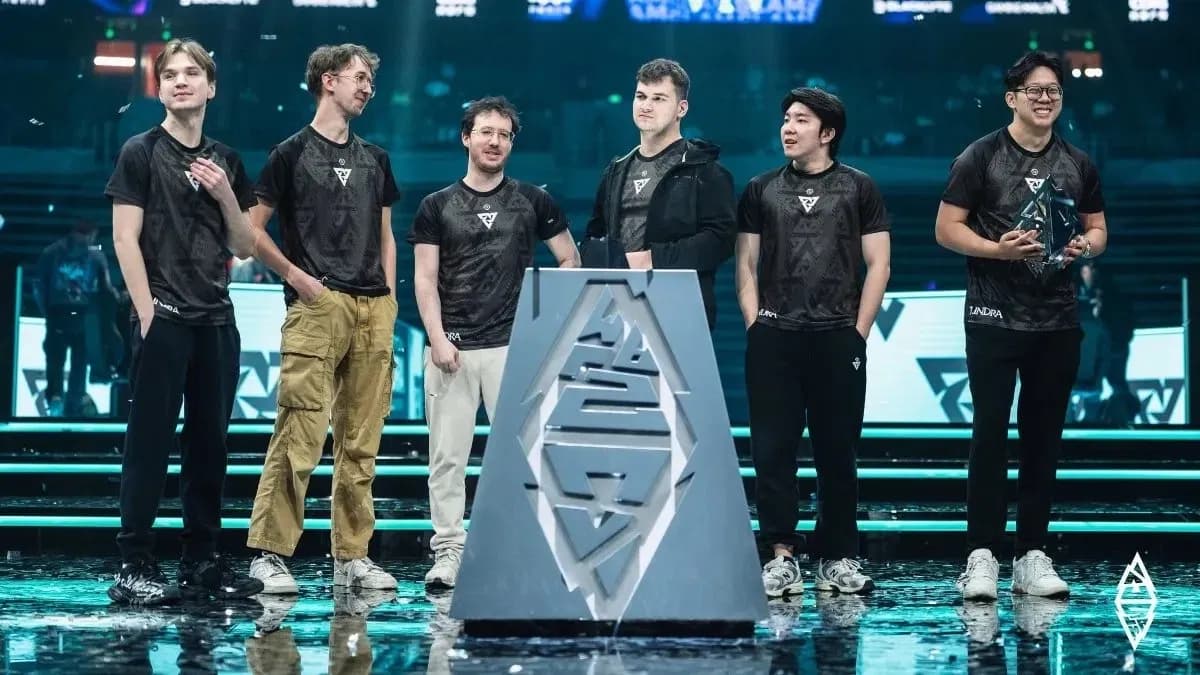
Tundra Esports lift one of their final trophies. Six years, one Aegis, and a legacy that ends with the brand stepping away from Dota 2. Image: BLAST
Six years, one Aegis of Champions, three consecutive BLAST Slam titles. And just like that, silence. Tundra Esports leaves Dota 2 after a shock announcement on June 1, 2026. The entire active roster and coaching staff is transferring to 1win Team for the remainder of the 2026 season. Their brand is dying. The players are not.
This is one of the most surprising departures in modern Dota 2 history. Tundra were not a struggling org. They were not on a downward slope. In fact, the 2025-2026 season has been the most successful run of the organization’s entire existence. Tier 1 trophy after Tier 1 trophy. A direct invite already secured for The International 2026 in Shanghai. And then, on a Sunday evening, the announcement dropped that Tundra leaves Dota 2 effective immediately.
Tundra Esports posted the announcement on their official social channels on June 1. The statement confirmed that their full Dota 2 lineup is moving to 1win Team. It did not explicitly say Tundra is leaving Dota 2 forever, but it also did not announce plans for a new roster. As a result, the organization has effectively exited competitive Dota 2 after six years in the scene.
We have something important to tell you!
— TUNDRA (@TundraEsports) June 1, 2026
To keep up with the players, new adventures, and the latest news, follow @onewin_dota2! pic.twitter.com/d4DPrW6SMG
The roster making the move includes the entire active lineup:
The staff also follows them across: analyst degaz, team manager Jamba, and sports director SweetyPotz all join 1win Team alongside the players. Therefore the move preserves the entire structure, not just the five players on the active roster.
Here is the wrinkle that makes the story of how Tundra leaves Dota 2 genuinely historic. The roster keeps its direct invite to The International 2026 in Shanghai, because TI invites are assigned to the roster’s core rather than the organization. As a result, the team will play at TI 2026 under the 1win Team banner instead of Tundra’s.
Tundra had been one of seven teams to receive a direct invite earlier this year. They earned it through the most dominant single-season run in the organization’s history. The fact that 1win effectively picked up a TI-invited roster overnight, without going through qualifiers or paying a buyout premium that was made public, makes this one of the cleanest acquisitions of an elite Dota 2 lineup in recent memory.
There is one complication, though. 1win already had an existing EEU Dota 2 roster competing in European Qualifiers under the “enjoy” tag. The acquisition of the Tundra players forces 1win to manage two separate Dota 2 projects. Specifically, the existing enjoy lineup may also need to rebrand to avoid breaching tournament rules around sponsorship overlap.
To understand the scale of this departure, you have to remember what Tundra built over six years.
The 2022 TI win: Tundra lifted the Aegis at The International 2022 in Singapore. They went through the entire playoffs without dropping a single series. Even with the depth of the field that year, no team came close to taking them down. This remains one of the most dominant TI runs of the modern era.
The 2025-2026 dynasty: Three consecutive BLAST Slam titles (Slams III, IV, and V) in late 2025 alone. Then DreamLeague Season 28 in early 2026. Then ESL One Birmingham 2026. Plus FISSURE Universe Episode 4 thrown in for good measure. Five Tier 1 titles in roughly six months. As a result, Tundra entered 2026 as one of the most feared teams on the EPT leaderboard.
The recent stumble: BLAST Slam VII in May 2026 was the team’s first real off-event of the cycle. They finished 9th-10th, earning just $15,000 in prize money after dropping out at the Last Chance Qualifier stage. Whether that result accelerated the conversations that led to the move is unclear, but the timing has not gone unnoticed.
Tundra’s official statement did not give a detailed reason for the exit. The organization framed the move as “a new chapter” rather than a closure. They thanked their partner WINLINE for years of support and praised their players for the era they built together. However, no specific business or financial explanation has been provided for why Tundra leaves Dota 2 in the middle of arguably their best competitive run.
The broader context is telling, though. Tundra’s exit follows similar departures from HEROIC and paiN Gaming, both of whom left Dota 2 in the spring of 2026 citing financial sustainability concerns. Specifically, South American organisations have been particularly vocal about how difficult it has become to operate a Tier 1 Dota 2 program. Therefore Tundra leaving the space, even after their most successful season ever, raises uncomfortable questions about whether the economics of professional Dota 2 work for anyone right now.
For 1win, the math is different. 1win is the esports division of a crypto entertainment brand with money flowing in from a different revenue stream entirely. They can absorb costs that traditional esports orgs cannot. Furthermore, they get a TI-invited roster delivered to their doorstep without the years of incremental investment Tundra had to make to build it. As a result, the deal probably looks like a steal from 1win’s perspective.
The fact that Tundra leaves Dota 2 overnight, even after a season like 2025-2026, sends an unmistakable signal. Building a Dota 2 org through sustained competitive investment may no longer be the smart financial play. Buying or absorbing existing rosters appears to be the more efficient path. As a result, expect more transitions like this in the coming months as the TI 2026 race intensifies.
The bigger question is whether Valve will respond. The current Dota Pro Circuit and EPT system rewards rosters more than organisations. Specifically, prize money flows primarily to players. Invites belong to the players. Therefore the brand carrying the jersey becomes increasingly fungible. Furthermore, that arrangement disincentivises long-term org investment because the very assets being built can be poached or transferred at any moment.
For the remaining established Dota 2 orgs, the pressure is real. Team Spirit, Team Liquid, Falcons and the few other survivors at the top of the EPT leaderboard now operate in an environment where roster acquisition costs are dropping and brand-loyalty has become a luxury. As a result, the TI 2026 cycle may end up being defined as much by which organisations survive it as by which roster lifts the Aegis.
The TI 2026 storyline writes itself. The former Tundra players, now under 1win, will arrive in Shanghai as one of the most experienced rosters in the tournament. Pure, bzm, 33, Ari, and Whitemon have played together long enough that their team chemistry is the strongest asset they bring. MoonMeander’s coaching has been a defining piece of their 2026 run.
If they win TI 2026 under the 1win banner, the conversation about org-brand value in Dota 2 changes overnight. Specifically, a TI title delivered to a brand that did not build the team would be the loudest possible argument that the org layer matters less than ever. Conversely, if they crash out early under the pressure of the rebrand, the story becomes about whether ripping a roster out of its environment mid-season was a strategic mistake.
Either way, the Tundra Esports era in Dota 2 is over. After 2022’s Aegis, after three BLAST Slams, after DreamLeague S28 and ESL One Birmingham, the curtain quietly fell on one of the modern era’s most decorated teams. The players move on. The achievements stay forever in Tundra’s history.
This is the third high-profile Dota 2 organization to exit competitive play in 2026. HEROIC and paiN Gaming preceded the news that Tundra leaves Dota 2 in the spring. As a result, the year has now seen three of the more established names depart in less than four months. Therefore, when the dust settles on TI 2026, the conversation about how to run a sustainable Dota 2 program will likely dominate the off-season more than any specific roster shuffle.
For fans, the consolation is that the players are still here. Pure, bzm, 33, Ari, Whitemon and MoonMeander are not going anywhere. The brand changes. Jerseys change. Their faces and gameplay stay exactly the same. And in Shanghai, in October 2026, they will get the chance to write the final chapter of the story that began the day Tundra leaves Dota 2 behind.
For wider Dota 2 coverage heading into TI 2026, our Dota 2 news hub tracks every move that shapes the road to Shanghai.
Dota2Team Falcons DOTA 2 just won The International a year ago, but now the roster is disbanding. Here’s everything we know.
 Dota2
Dota2LGD Gaming returns to Dota 2 after two years by signing the ex-HEROIC South American roster. The Chinese org targets TI 2026 in Shanghai.
 Dota2
Dota2Valve wrapped the Tidehunter Arcana in a 1-in-100,000 drop rate and a pity timer that can hand you the wrong Arcana. Here is what the Trove of Terror actually costs before you open a single chest.