Riot Voice Evaluation Now Covers Spanish, Portuguese and Korean: What Counts as Toxic in VALORANT?
Riot Voice Evaluation now detects toxic voice comms in Spanish, Portuguese and Korean. Here’s what still counts as fair trash talk, and how to report players who cross the line.
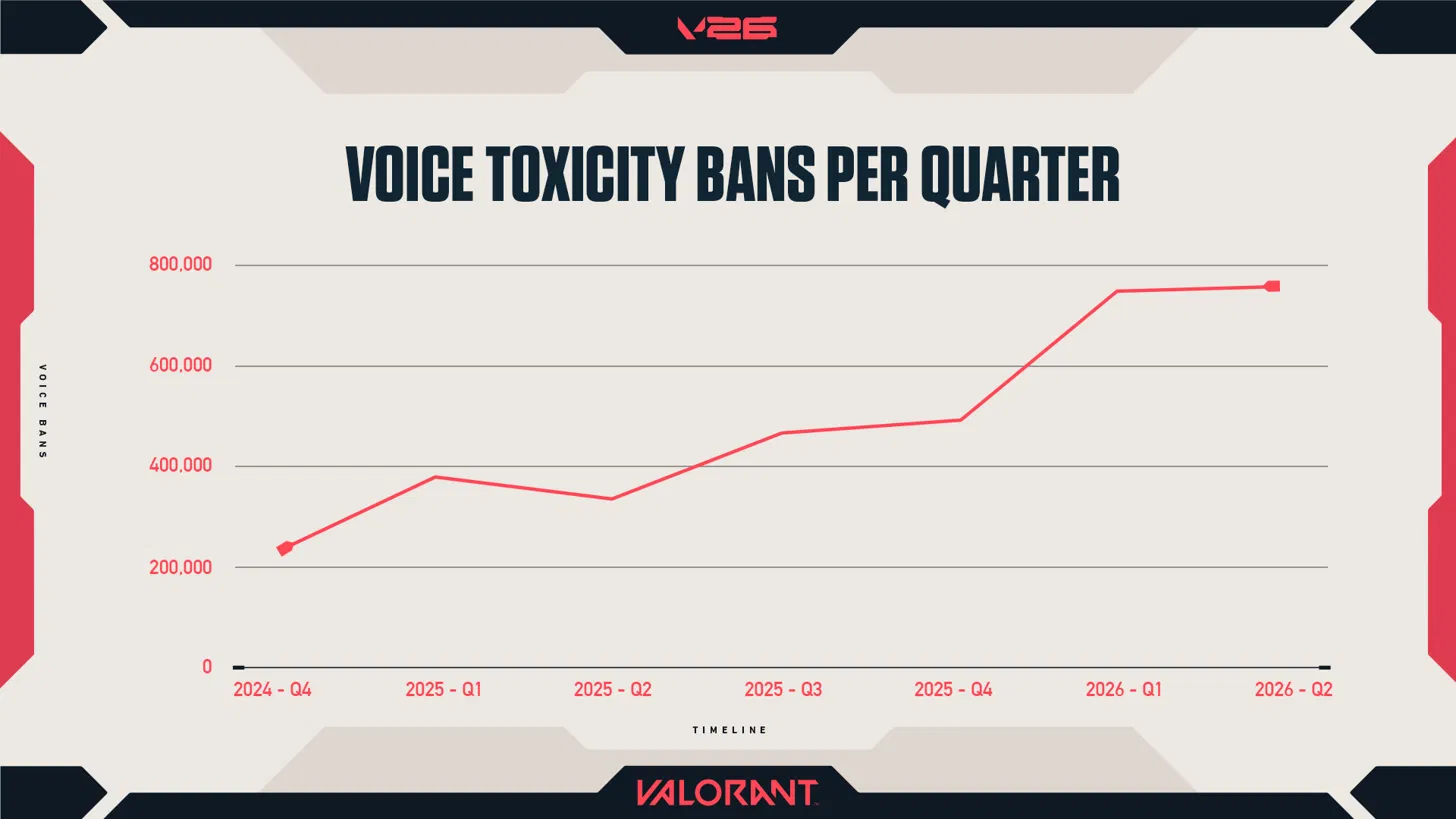
VALORANT voice toxicity bans climbed to around 750,000 per quarter in 2026. (Image: Riot Games)
If you play VALORANT in Spanish, Portuguese or Korean, your voice comms are now under closer watch. Alongside patch 13.06, Riot expanded Riot Voice Evaluation (RVE), its in-game system for catching abusive voice chat, to those three languages. More languages are due in the coming months.
Riot also published a longer post on what it considers over the line. Here is what changes, what is still fine, and how to report someone who crosses the line.
What is Riot Voice Evaluation?
Riot Voice Evaluation is the tech VALORANT uses to detect and penalize toxic voice comms in matches. It works alongside player reports rather than replacing them.
According to Riot, recent upgrades to RVE helped it catch and penalize twice as many cases of voice comms abuse over the last year. That’s a big jump. Now the same system is getting better at understanding the languages of three of the game’s largest non-English player bases, covering huge chunks of the LATAM, Brazil and Korea servers.
How many VALORANT players get banned for voice chat?
More than ever. Riot’s chart of voice toxicity bans shows the curve climbing steadily since late 2024.
Q4 2024: around 240,000 voice bans.
Q2 2025: roughly 335,000.
Q1 and Q2 2026: about 750,000 per quarter.
In other words, voice bans have roughly tripled in 18 months. Comparing Q2 2025 with Q2 2026, they more than doubled, which matches Riot’s claim of catching twice as much abuse. Keep in mind that the chart ends before the Spanish, Portuguese and Korean expansion. The next quarters will show whether the new languages push that number even higher.
Is trash talk still allowed in VALORANT?
Yes. Riot was clear that Riot Voice Evaluation is not meant to wipe out all trash talk. Instead, the rule of thumb is simple: keep it about the game, not the person.
Fine: questioning a play, banter with the enemy team, the usual competitive back and forth.
Not fine: repeated personal attacks, threats, targeting someone’s identity, hate speech and slurs.
The pro scene works along similar lines. Just this week, VALORANT’s head of esports confirmed that shooting bodies and teabagging is fine at Champions Shanghai.
Riot also asks players to read the room. If teammates go quiet or push back because of how you talk, or you keep getting reported, it’s time to dial it down. Riot even summed it up bluntly in its post: “no one needs to be an asshole.”
Can you get banned for defending yourself?
You can, if your defense turns into abuse. Riot says you are allowed to stand up for yourself when someone targets you. However, being provoked doesn’t give you a free pass.
If an argument escalates and both players cross the line, both can be penalized. Context matters, but slurs or hate speech in a reply still count as slurs or hate speech. Riot’s advice is to keep your own comms clean and report the other player instead of trading insults.
How to report voice comms abuse in VALORANT
Voice comms abuse is reported under the Play With Respect column in VALORANT. (Image: Riot Games)
Reports matter more than most players think. Riot Voice Evaluation is only one half of the system, and reports tell Riot which interactions to look at.
Open the settings menu during the match and go to the Match tab.
Click Report next to the player’s name.
Tick Voice Comms Abuse under the Play With Respect column. You can select up to three offenses if the player did more than one thing.
Add context if you want. There is an optional text field with a 512-character limit.
Hit Report. You can also mute the player’s text chat from the same window.
Notice how the report menu follows the Community Pact: Play to Win, Play Fair and Play With Respect each get their own column. Every report also helps Riot improve its detection systems, so it’s worth the ten seconds even if you never see the result.
Why is Riot pushing this now?
It’s part of a bigger push. Earlier this year, Riot introduced the Riot Games Community Pact, built on three rules: play to win, play fair and play with respect. The fourth line tells players who can’t do that to go play something else.
The “play fair” side has already produced numbers. The new anti-boosting detection bans around 1,600 accounts a day, with more than 90,000 gone since July 20. Across both of its big competitive games, Riot has now banned almost 300,000 accounts for boosting. Voice detection is the “play with respect” half of the same plan. You can read the full breakdown of everything else in our VALORANT patch 13.06 article, or check the official patch notes from Riot.
Will Riot Voice Evaluation actually fix toxic comms?
Not on its own, and Riot admits as much. It says it can’t remove disruptive behavior overnight. Still, doubling detection in a year is real progress, and adding three major languages closes a gap for a big part of the non-English player base.
The honest answer is that it depends on players reporting. Every language the system can’t properly understand leaves players unprotected. That gap is now smaller, and the reports you file decide how fast it shrinks further.



 VALORANT
