VCT 2027 Roster Rules: The Three-Player Rule Breaking Up VALORANT’s Best Teams
Two of our own articles asked why so many teams are walking away from VALORANT. The answer is in Article 108 of Riot’s rulebook, and almost nobody has read it.
Article 108 caps every starting lineup at two non-residents (Image: Riot Games)
The VCT 2027 roster rules fit in two lines of Riot’s rulebook, and they have done more damage to VALORANT lineups this month than any partnership decision.
Three players on your starting five must be residents of your home region. You get a maximum of two who are not.
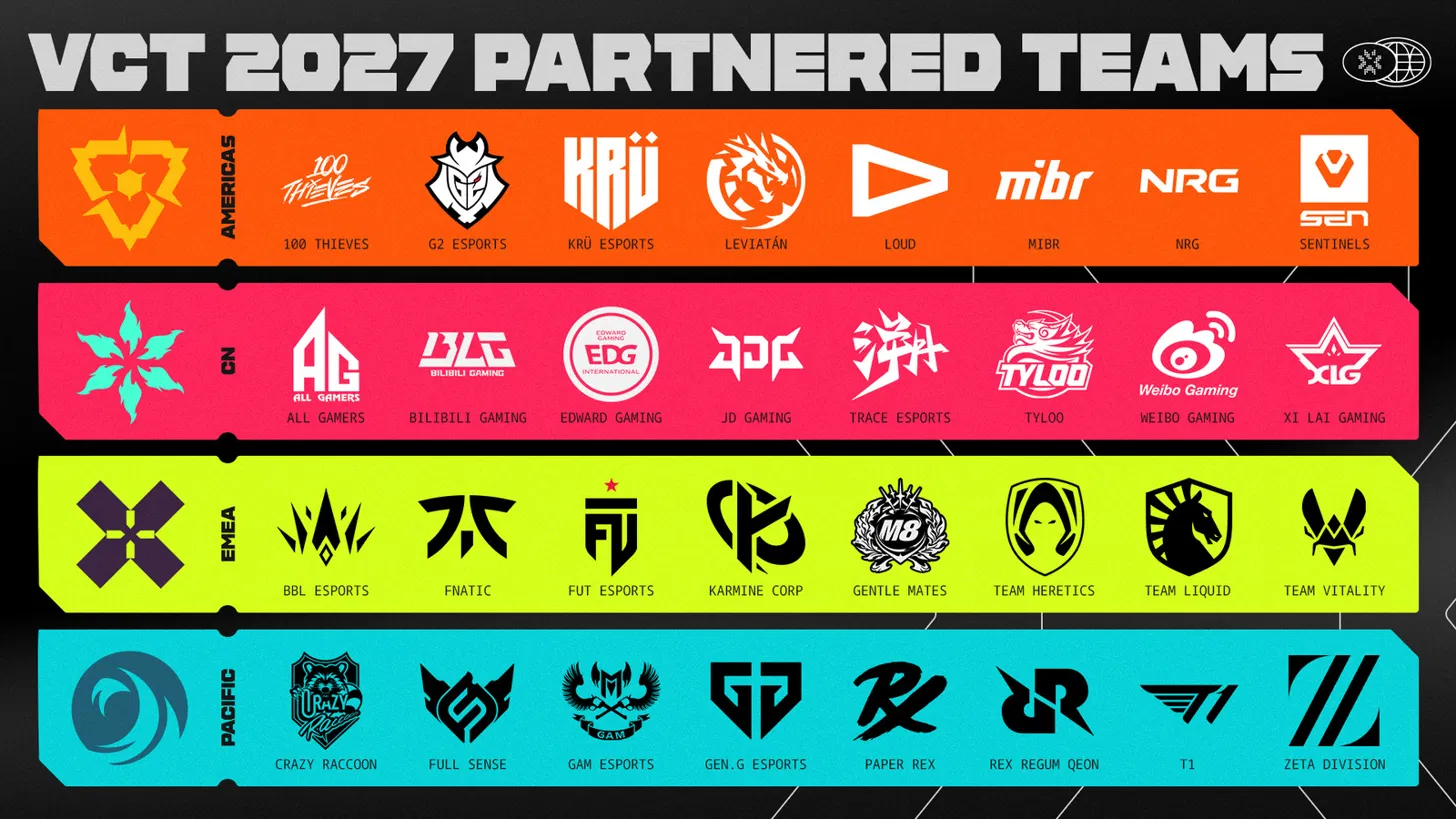
That is Article 108. It is why MIBR moved aspas, zekken, Verno, Mazino and tex to the inactive roster on October 25, three days after Riot confirmed the org as a 2027 partner team.
What the VCT 2027 roster rules actually say
Riot published the VCT 2027 roster rules in the VALORANT Champions Tour Global Policies for 2027. Section D covers rosters, and the relevant line is short.
Teams must keep “at least three players on their Starting Lineup who are Residents of the Team’s Home Region” and “may have a maximum of two players on their Starting Lineup who are non-Residents”.
The requirement holds in inter-regional play and at international events, and every substitution has to comply too. There is no version of a match where a team fields three imports legally.
Why the Americas got hit hardest
Here is the part most coverage leaves out. The rule itself is not new in spirit. What changed is the definition of a home region.
VCT 2027 splits the four big regions into 14 separate regional competitions. The Americas alone becomes four: North America, LATAM North, LATAM South and Brazil.
So a Brazilian org no longer has the Americas as its home region. It has Brazil.
Run MIBR’s 2026 roster through that. aspas is Brazilian. Verno, tex and zekken are American. Mazino is Chilean. One resident, four non-residents, against a limit of two.
The roster did not become worse. It became ineligible.
MIBR’s 2026 five against Article 108. The limit is two (Graphic: EsportNow.gg)
The legacy exception, and why it did not save MIBR
Riot did build a door. Articles 109 to 112 cover what it calls Legacy Partner Teams, meaning orgs that were partners in 2026 and were accepted into the 2027 cycle. MIBR is one.
Those teams can apply for legacy exceptions for players already on the 2026 roster. Article 110 allows a lineup to “exceed the maximum limit of two non-Resident players” but only “if all of those non-Resident players have an active legacy exception”.
On paper, MIBR qualified. Article 111 requires the player to have been registered with the team before the end of Stage 2 of the 2026 season, and all four joined by December 2025.
Two things made that door narrower than it looks.
It is discretionary. Article 109 grants exceptions at Riot’s discretion. Nobody is entitled to one.
It expires with the contract. Article 112 ties each exception to that player’s Esports Services Agreement. When the deal ends, so does the exception, unless Riot extends it.
A partnership runs two years. The exemptions do not. Building a title push on four of them means re-signing four players and asking Riot to renew four permissions, every time.
MIBR’s own statement points straight at it. The org said it decided to “reassess its Valorant roster for the upcoming season” because of “the significant changes to the competitive structure for 2027, including the regional transition”, and that the move followed “discussions with the players’ representatives”.
Two different things are happening, and they keep getting mixed up
October produced a wave of departures, but they do not share a cause, and only some of them trace back to the VCT 2027 roster rules.
The player with a Champions trophy and an Americas MVP award is on the market.
aspas won Champions with LOUD in 2022, the first Brazilian team to do it, beating OpTic Gaming 3-1 in the Istanbul final. LOUD took the first VCT Americas title in 2023 with a third place at Champions. He moved to Leviatán in 2024, won Americas Stage 2 and finished third at Champions again. He joined MIBR for 2025.
His post after the MIBR decision says he is “exploring my options for the future and open to teams in ALL REGIONS” and “Hungry to compete and win trophies!”
Read that against Article 108 and the market gets strange. As a Brazilian resident, aspas counts toward the three-resident requirement in Brazil and against the two-import cap everywhere else. He is a free signing for a Brazilian org and a roster-shaping decision for anyone else.
The clause nobody is talking about
Article 113 is the one worth bookmarking.
Any player who has competed in a Game Changers competition during the current year or the previous two counts as a resident for regional roster requirements in non-Game Changers VCT play.
That is a real competitive lever. A team one resident short of compliance has a pool of eligible players that most orgs are not looking at yet.
What this means for Kickoff
Every partner team goes into Kickoff in January, and every one of them has to be compliant or exempt by then.
So the next few weeks are not ordinary roster churn. Orgs are not just buying the best five players they can afford. Because of the VCT 2027 roster rules they are buying the best five players who are legal in their region, which is a different and much smaller market.



 VALORANT

