

 LOL
LOL2XKO Samira and Sett Release Date: Oct 27 Final Update
Riot just added a surprise to 2XKO. Sett joins Samira in the game’s final content update on October 27, 2026. Here is what we know about both fighters.
8 Oct 20265 min
LoLteamfight tacticsRiot has reviewed TFT Space Gods and admits Set 17 was rushed. Here is why Carousel is returning and what changes for Enchanted Wilds.
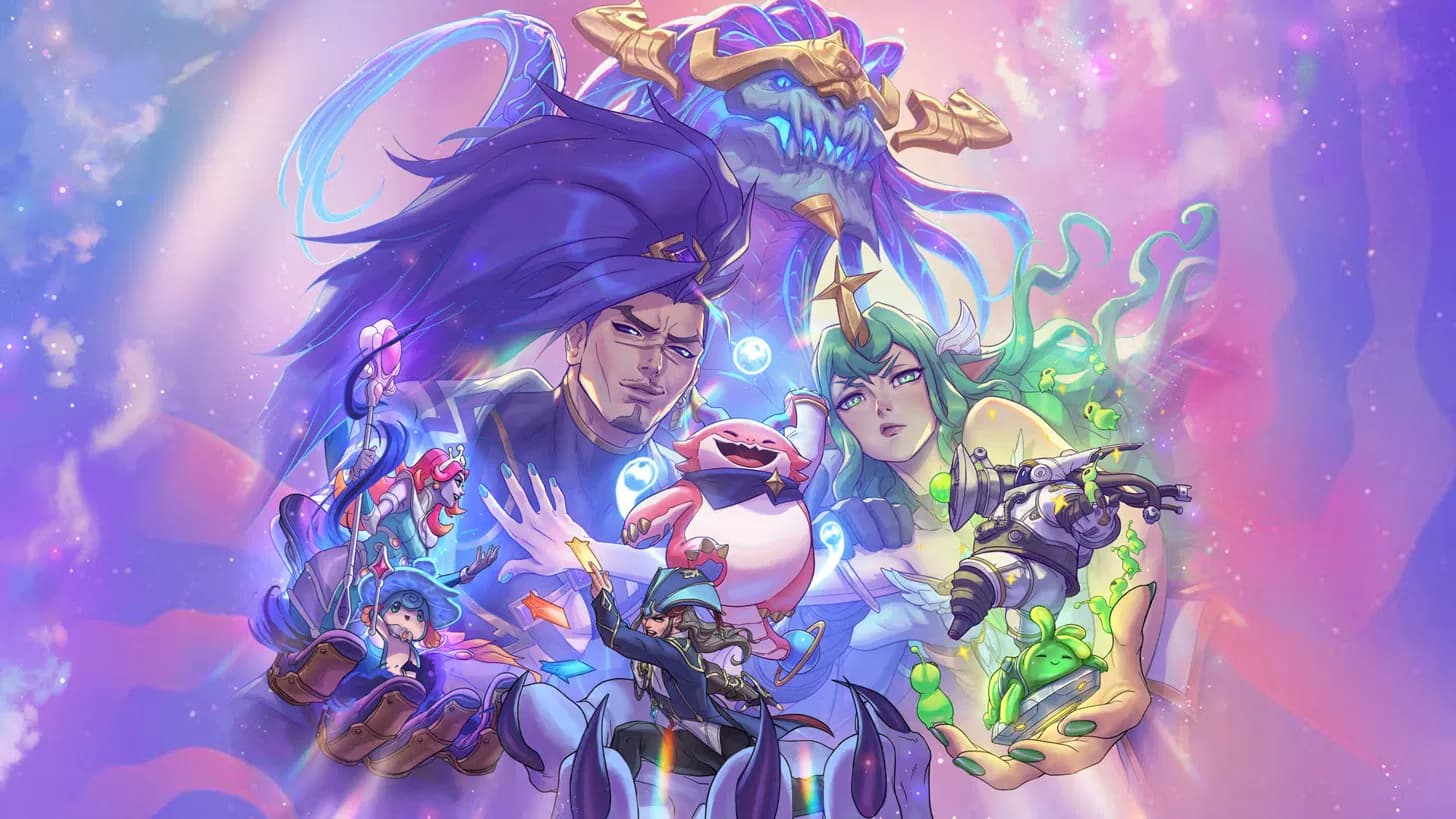
Riot’s dev team reviewed what worked and what missed across Space Gods. Credit: Riot Games
Riot has published its review of TFT Space Gods, and it is not a victory lap. The dev team went through Set 17 mechanic by mechanic and explained what missed, and the reason underneath most of it is a scheduling decision players never saw.
Riot never intended Space Gods to be Set 17. The team originally planned it as Set 18, then swapped the order so the migration to Unreal Engine could land on Set 18 instead. That left Space Gods with a development window noticeably shorter than a set normally gets.
Everything else in the post-mortem grows out of that one call.
The version of the mechanic that shipped is not the version Riot pitched.

The original design was far bigger. It would have changed how Riot distributed Augments, replaced core item distribution, and even swapped out the items you get from PvE rounds. The timeline could not support the balance work it needed, so the team cut it.
What survived was Offerings and Boons, and the dev team’s own verdict is that the result played too safe. It never produced the game-to-game swing they were aiming for.
The 8-gold cap explains part of that. Riot deliberately held every God Offering to a power level of 8 gold or less, because Cyber City taught them what happens when a set mechanic inflates the economy. Set 14’s Hacks pushed three-star 4-costs into circulation and bent the meta toward fast-nine. Space Gods avoided that trap and walked into a different one: with a ceiling that low, designing Offerings that stayed interesting and balanced against each other became genuinely hard.
Riot then attached Offerings to item components to fix the flatness by forcing a real choice. On paper that is good design. In practice the team found it just made the decision feel like a chore.
There was a technical cost too. The God models ate into the memory budget on mobile, and Riot paid for them by lowering the quality of things like idle animations.
This is the part with the clearest consequences for Set 18 and beyond.
Riot is explicit that removing Carousel was never the plan. It happened because the Realm of the Gods needed somewhere to live, and Carousel’s slot was where it fit. The team then learned two things they could not have learned any other way.
The first is about comeback mechanics. A comeback mechanic that players cannot see does not work. Riot added a UI alert telling players they were getting different loot based on placement, and it still did not register the way a visible, active Carousel does. Carousel also let you pick from nearly every component on the wheel, which is more control than an anvil or armory screen can offer.
The second is about people. Carousel is where the lobby physically gathers, and the tension is the point. You watch what everyone else wants while protecting your own pick. The Realm of the Gods put all eight players on the same screen and produced almost no interaction at all, because nothing was at stake between them.
Riot’s conclusion: getting your component sniped is annoying, and emoting at each other afterwards is worth the annoyance.
Carousel changes are coming, though Riot places them in the more distant future rather than at Enchanted Wilds.
The minimap is a different story. The engine migration removes it entirely. On PC it was never really a gameplay tool, but it worked as a social one: it showed you where pings were coming from, which is how you spotted the high roller or clocked someone trying to three-star a 5-cost. Riot is now reworking pings into a social tool that does not depend on the minimap to function. That work will not arrive in time for Enchanted Wilds.
Lore & Legends ran 100 units. Space Gods went back to the standard roster, and Riot knew that would sting.
The team chased Set 16’s flexibility instead of its size. They flattened the trait web, building a horizontal set where splashing traits mattered more than committing to one vertical. Dark Star (2) got an execution effect. Stargazer (3) enhanced hexes for units outside the trait.
That worked for experienced flex players. It worked badly for everyone else. New players trying to learn the game lost the simplest on-ramp TFT has, which is picking one vertical and forcing it. Even strong players who enjoy vertical variations found something missing.

The 5-cost problem made it worse. Hitting Jhin for Dark Star (6) or Blitzcrank for Space Groove (7) is genuinely hard, and there is no satisfying version of playing a perfect econ game, reaching level 9, and still not finding the one unit your comp is built around. Riot compares it unfavourably to Meeple, where you reach Meeple (7) without Bard and simply slot him in if he shows up.
Dark Star’s lack of a frontline without an Emblem pushed the set further toward Emblem dependence.
Riot’s fix for Set 18 is to limit how many Origins need a 5-cost to reach their highest non-Prismatic breakpoint. Enchanted Wilds will not have an expanded roster either.
Threats take some blame as well. Space Gods used a lot of them, and because Threats sit outside the trait system, every Threat in the roster occupies a slot that cannot support a vertical’s capstone fantasy. Too many of them left the set’s biggest Origins feeling underbuilt.
Riot says plainly that this one was “a miss”.
The logic made sense at the time. The scrapped version of the Realm of the Gods generated enough variance on its own that Opening Encounters became redundant, so the team removed them. When the mechanic got scaled back, nobody added them again.
Two assumptions drove it. Riot thought checking both God options and an Opening Encounter at the start of a game would overload players, which turned out to be wrong. The team also wanted to move the inflationary power of Opening Encounters into the set mechanic itself, which failed because the mechanic never delivered the variance to justify it.
Putting them back mid-set caused real disruption. Riot has built Sets 18 and 19 with Opening Encounters from day one.
Space Gods launched short on tanks that fit multiple comps.
Every option came with a condition. Might Mech only worked in Mech form. Rhaast needed you playing horizontal. Tahm Kench’s budget went into resource production rather than durability.
Riot patched what it could quickly, then tried something unusual in 17.3: moving Morgana down in cost to create a flexible tank. That was a rare situation where the move was even possible, since Morgana sat as a bonus 5-cost with no dedicated comp, so demoting her broke nothing.
It half worked. She became flexible without becoming exciting, because she still had no comp to call home. Riot’s takeaway is that changing a champion’s cost damages trait webs and comp structures too much to work as a general tool.
This is the most transferable lesson in the whole post.
Space Gods carried more conditional traits than any set before it. Psionic’s items decided what you could play. Stargazer’s patterns decided your comp. Arbiter’s options limited what you could splash. Graves depended entirely on when you found him.
Riot defends the idea in isolation. Graves is a good conditional unit, because finding him early opens a build path that feels like a discovery.
The problem is proportion. TFT is already conditional at its core through Augments, item distribution and shop RNG. Stack conditional traits on top of that in a standard-sized roster and the conditions stop creating variance and start closing doors. Combine it with a thin tank pool and every lobby converges on the same handful of comps.
Riot normally builds Augments near the end of a set’s development, as the adaptive layer that slots into whatever the set turned out to be. For Set 17 those resources went to God Offerings and Boons instead.
Champion and trait Augments are how most players learn what a set wants them to do. In Space Gods they showed up after launch rather than with it.
Riot also put a question to players in the post, which is worth answering if you have an opinion. Their philosophy is that reroll 1-costs and 2-costs should not carry enough power to win a lobby on their own. So should a Champion Augment be enough to take you to first place? If the answer is no, then the fantasy of a Champion Augment is finishing third or fourth, which is not much of a fantasy.
Space Gods does not disappear. The set stays playable for a while after Enchanted Wilds launches, and Riot will keep tuning it.
The more useful read is what the post says about Set 18. Enchanted Wilds ships on Unreal. Opening Encounters return from day one. Fewer Origins will depend on a 5-cost to reach their ceiling. The roster stays standard size, and reworked pings will arrive later rather than at launch.
Riot’s own summary of the whole thing is the line worth remembering: seven years in, the team has gotten much better at making sets, but a set still needs time to cook. Space Gods did not get it.
Riot published the review on the official Teamfight Tactics site, written by the TFT dev team with input from Head of Gameplay Alex “BlueVelvet” Cole, Live Balance lead Tim “Truexy” Jiang and Space Gods design lead Noemi “Bluecove” Coute.
More League and TFT coverage lands on our League of Legends news hub.
LOLRiot just added a surprise to 2XKO. Sett joins Samira in the game’s final content update on October 27, 2026. Here is what we know about both fighters.
 LOL
LOLRiot made League of Legends replays private in Patch 26.20. Now, the changes are being delayed after the community spoke out.
 LOL
LOLHEARTSTEEL return on October 7 with six skins, a Prestige Sett and a chroma list long enough to need its own spreadsheet. Riot also brought back the 2013 SKT T1 skins as Elite chromas.