

Leaks
Overwatch Team Confirms Big Map Voting Changes ‘Soon’
Overwatch devs have confirmed Map Voting is changing “soon.” Let’s explore why and how the updates are happening.
3 Sept 20263 min
Every Rocket League rank from Bronze I to Supersonic Legend, with the MMR range behind each tier, where most players land, and the habits that move you up.
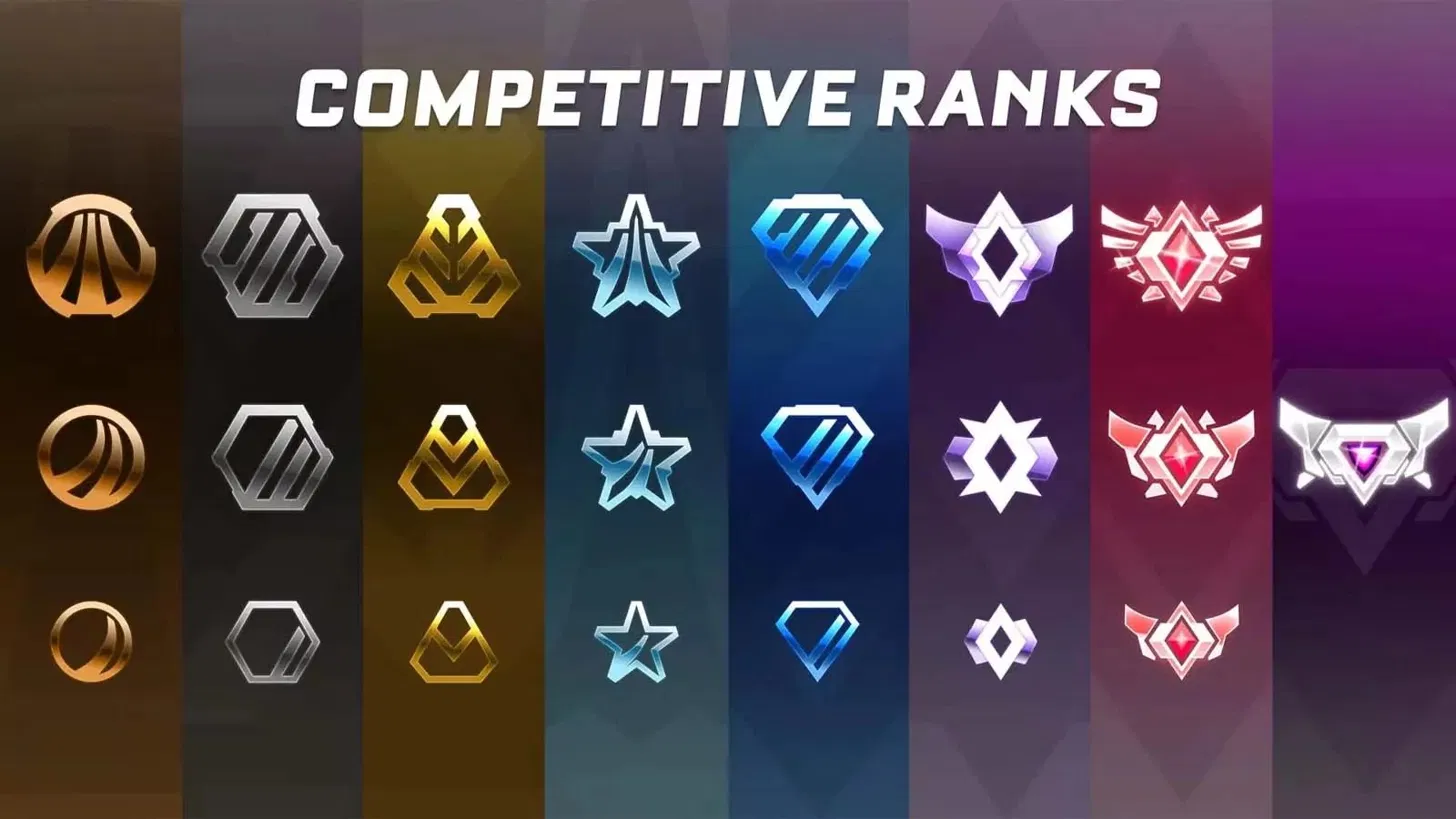
Every competitive tier from Bronze up to Supersonic Legend. Image credit: Psyonix
Show Image
Rocket League ranks run from Bronze I at the bottom to Supersonic Legend at the top, 22 in total, and behind every one of them sits a hidden MMR number that decides who you face and whether you climb or slide back. Gold holds the biggest slice of the ladder, roughly a quarter of all ranked players, so if you feel stuck there, you have plenty of company. This guide covers all 22 Rocket League ranks in order, the MMR range behind each tier, where players actually sit, how the system reads your skill, and the habits that move you up.
Eight main tiers make up the competitive ladder. Every tier except Supersonic Legend then splits into three sub-ranks (I, II, III), and each one owns its own MMR band. Cross the threshold above you and you promote, but drop below the floor of your current rank and you demote. Simple in theory, brutal in a loss streak.

| Rank | Approx. MMR (Standard 3v3) |
|---|---|
| Bronze I | 0 – 175 |
| Bronze II | 176 – 215 |
| Bronze III | 216 – 255 |
| Silver I | 256 – 295 |
| Silver II | 296 – 335 |
| Silver III | 336 – 375 |
| Gold I | 376 – 435 |
| Gold II | 436 – 495 |
| Gold III | 496 – 555 |
| Platinum I | 556 – 635 |
| Platinum II | 636 – 715 |
| Platinum III | 716 – 795 |
| Diamond I | 796 – 895 |
| Diamond II | 896 – 995 |
| Diamond III | 996 – 1095 |
| Champion I | 1096 – 1195 |
| Champion II | 1196 – 1295 |
| Champion III | 1296 – 1395 |
| Grand Champion I | 1396 – 1535 |
| Grand Champion II | 1536 – 1675 |
| Grand Champion III | 1676 – 1899 |
| Supersonic Legend | 1900+ |
These are approximate Standard (3v3) values, and they shift a little every season after the reset. For live numbers pulled from public profiles, Tracker.gg is the one most players check.
There is one more layer below the ranks above, and it trips up a lot of newer players. Inside every sub-rank, from Bronze I up to Grand Champion III, you have four divisions labelled I, II, III, and IV. Division I is the bottom of a sub-rank, while Division IV is the top.
Divisions move the most. Two or three wins is usually enough to bump you up one, and the same goes the other way on a bad night. So once you climb past Division IV you promote to the next sub-rank, but if you fall out of Division I you drop back. A full rank therefore reads as tier, then sub-rank, then division, for example Champion I Division IV.
Supersonic Legend ignores all of this. No sub-ranks, no divisions, just a raw MMR total. That total is what the in-game Top 100 leaderboard runs on.
Gold and Platinum together hold just over half the ranked population. Here is the rough breakdown across all Rocket League ranks:
Show Image
| Tier | Approximate % of players |
|---|---|
| Bronze | ~5% |
| Silver | ~15% |
| Gold | ~27% |
| Platinum | ~22% |
| Diamond | ~14% |
| Champion | ~9% |
| Grand Champion | ~3.5% |
| Supersonic Legend | ~0.1% |
A few things are worth pulling out of that table.
First, Gold and low Platinum are the most crowded part of the ladder. Most players reach Gold within a season or two and then stall, and the average Standard player lands somewhere around Gold III to Platinum II. Platinum, therefore, is where the long plateau tends to set in.
Diamond, on the other hand, is comfortably above average. If you are Diamond, you sit in roughly the top quarter of competitive players. It never feels that way when your teammate triple-commits into an open net, but the numbers hold.
Grand Champion is inside the top 4%, while Supersonic Legend is the top 0.1%. The jump from Champion III to Grand Champion I is where most casual players stop for good, and it is not because the game changes. Instead, it is because the consistency bar jumps and the room for error shrinks.
Every ranked match moves your MMR. Win and it goes up, lose and it drops. How much it moves comes down to two things.
The first is the expected result. Because the system knows your MMR and your opponents’ MMR before kickoff, beating a team rated higher than you earns more than beating an equal team. Likewise, losing to a lower-rated team costs more than losing to an equal one. Standard skill-rating logic.
The second is confidence. New accounts, and accounts that have not played in a while, carry more uncertainty, so their MMR swings harder in both directions. As you play more games in a season, though, the swings settle down while the system gets surer of where you belong. Psyonix has never published the exact maths, but that behaviour lines up with rating systems in the Glicko and TrueSkill family.
One thing the system does not do: it ignores your individual stats. Goals, saves, assists, shots, none of it touches your MMR, because it is pure win/loss. Pull off three game-saving demos in a 2-3 loss and you still drop points. That changes how you should think about improving, since the only number that matters is whether your team wins, which means your contribution to the win is the thing that counts.

Two things happen at the start of every season.
First, your MMR gets a soft reset. Psyonix pulls your rating down from where you finished, usually by a few hundred MMR. The formula moves season to season, but the effect is the same: high-ranked players show up several tiers lower before the season properly begins. For example, a Grand Champion who finished at 1600 might open the new season nearer 1200 to 1300 until placements pull them back.
Then you play ten placement matches per playlist. Swings during placements run bigger than normal, which lets the system find your range faster. After ten games your starting rank is locked and you are back in normal ranked.
Placement results matter, but your pre-reset MMR matters more. A Champion II from last season is not getting dumped into Silver over a rough placement run, because the soft reset caps how far you can fall. And placements do not carry across playlists, so Standard, Doubles, and Duel each run their own ten games and their own starting rank.
Your rank in this game is not one number. Instead, it is a set of them, one per playlist, which surprises anyone coming from a game with a single unified rating.
Standard (3v3) is the main mode and the one most players and analysts treat as the benchmark. Say you are Diamond and people assume you mean Standard.
Doubles (2v2) runs its own MMR. Plenty of Standard Platinums sit a tier lower in Doubles, because reading one teammate is a different job from reading two.
Duel (1v1) sits on much lower thresholds, so Champion in Duel is not the same skill level as Champion in Standard. A lot of strong Standard players dodge Duel, since there is no teammate to cover a mechanical gap.
Extra Modes (Hoops, Rumble, Dropshot, Snow Day) each track separate MMR too. For most people these are closer to casual, so they are not where you measure your real rank.
If you want a single honest read on your skill, use Standard. It is the playlist RLCS pros ladder in between events, and the one Liquipedia leans on when tracking competitive activity. You can also see all your playlist ranks at once on Tracker.gg by searching your Epic name or Steam profile.
All Rocket League ranks fall into one of these tiers, and each one tells you something specific about what to fix next.
These are about building the basics. Ball-chasing is normal here, while rotation and positioning are not really on the radar yet. The way out is not clever rotation. Instead, it is cleaner first touches, collecting boost without abandoning the play, and walking away from 50/50s you were never going to win.
Gold is where rotation starts to separate people. The chasers are still around, but the better Gold players are learning to leave a ball alone. The usual problem is one player committing while the other two trail in behind instead of holding. So the skill to build here is patience. Not every ball is yours.
Platinum is the plateau everyone talks about. The mechanics show up in flashes but not on demand. Aerials happen, then miss. Rotation holds, then collapses under pressure. The wall here is rarely mechanical, though. It is consistency. Plenty of Platinum players already have Diamond-level touch, they just cannot land it at match pace yet. Because of that, deliberate free-play reps for aerial consistency move the needle more than another tilted queue.
Diamond is where the game starts to feel different. Players win more 50/50s, rotate more reliably, and challenge in the air without flinching. Still, the gap from Diamond I to Diamond III is real. Low Diamond is a mechanical floor more than a ceiling, while high Diamond is where game sense starts catching up to mechanics.
Champion is where both halves come together. These players read the play before it develops, rotate on instinct, and challenge aerials without second-guessing. Getting from Champion to Grand Champion asks for all of it at once, which is harder than sharpening any single skill.
Grand Champion is the top 3 to 4%. The three sub-ranks inside it cover a wide skill range, so a GC I and a GC III wear the same badge while playing very different games. Pro tryouts usually start around here, and active RLCS pros sit at or near Supersonic Legend when they are laddering.
Supersonic Legend, finally, is the top 0.1%. Most active pros, including the ones competing in RLCS, live here when they queue ranked. Players like M0nkey M00n, zen, and Vatira show up in this pool, and it is small enough that you will run into the same opponents two or three times in one session.
Show Image
Most improvement content is about mechanics. Most players, however, would climb faster by fixing habits first.
Splitting time across Standard, Doubles, and Duel spreads your placements thin and slows the system down on settling your real skill. So if Standard is the goal, queue Standard.
Your aerial ceiling does not get built in ranked. Instead, it gets built in free play and custom training packs. Ten focused minutes before a session beats ten extra ranked games played on tilt.
In Gold and Platinum, the most common way a team loses is all three players committing at once with nobody home. The fix is not begging your teammates to rotate. Rather, it is training yourself to hold when the ball is already covered. Fifteen minutes of watching your own replays for rotation mistakes is the best free coaching tool in the game.
Loss streaks tend to feed themselves, partly because the system is recalibrating you downward, partly because frustration tanks your play. Sunless Khan has broken this down on his channel, and it comes up in every serious coaching video. Two losses, close the game, come back tomorrow.
A Gold player chasing Platinum should be drilling Platinum-level skills in free play. Otherwise, grinding ranked at your current level mostly reinforces your current ceiling. The Rocket Science channel covers the mechanical gaps between ranks in detail if you want a concrete target.
How many ranks are there in Rocket League? There are 22 Rocket League ranks across 8 tiers, from Bronze I to Supersonic Legend. Every tier except Supersonic Legend has three sub-ranks (I, II, III), and each sub-rank holds four divisions.
Is there rank decay in Rocket League? No. You are not punished for not playing, so your rank stays put until you queue again. Unlike Overwatch 2, the top ranks never decay.
Is there demotion protection? Yes, but only briefly. When you promote into a new rank, you get a short buffer against dropping straight back. It lasts a few games at most, though, and will not save you from a sustained losing run.
Can I see my exact MMR in-game? No. Rocket League hides the raw number, so you see your badge and your progress toward the next rank but not the figure underneath. Tracker.gg displays it using public profile data.
Why is my rank different in each playlist? Each playlist runs independent MMR built from its own match history. Because of that, your Standard and Doubles ratings are completely separate, and most players sit lower in the modes they play less.
What rank do pro Rocket League players hit in ranked? RLCS pros are almost all Supersonic Legend when they are actively queuing, while regional semi-pros and top amateurs usually sit in Grand Champion. If you are Champion eyeing pro play, Champion III is where that starts.
What counts as a good rank in Rocket League? Diamond is a fair line to aim for, since it puts you in roughly the top quarter of competitive players. Champion, meanwhile, is impressive for anyone playing on the side.
For RLCS results, roster moves, and season-by-season updates on every rank, keep up with our Rocket League coverage.
Overwatch devs have confirmed Map Voting is changing “soon.” Let’s explore why and how the updates are happening.

Eleven weeks to launch, and Rockstar has finally shown the game running. What the Extended Look revealed, what the August leak was really about, and the one part of GTA 6 nobody at Rockstar will talk about.

Overwatch fans just got a first look at another LE SSERAFIM skin collab. Here’s everything we know, including a release date.