

 CS2
CS2Full Guide to Chicken Pets in CS2: How to Hatch, Drop Rates, All Colors
Here’s everything Counter-Strike players should know about the new Chicken Pets, including how to get them and all available colors.
23 Sept 20267 min
CS2GUIDESLearn how to trade CS2 skins safely in 2026. Real fees explained. The seven scam types every trader must know. Skinport, CSFloat, BUFF163 compared.
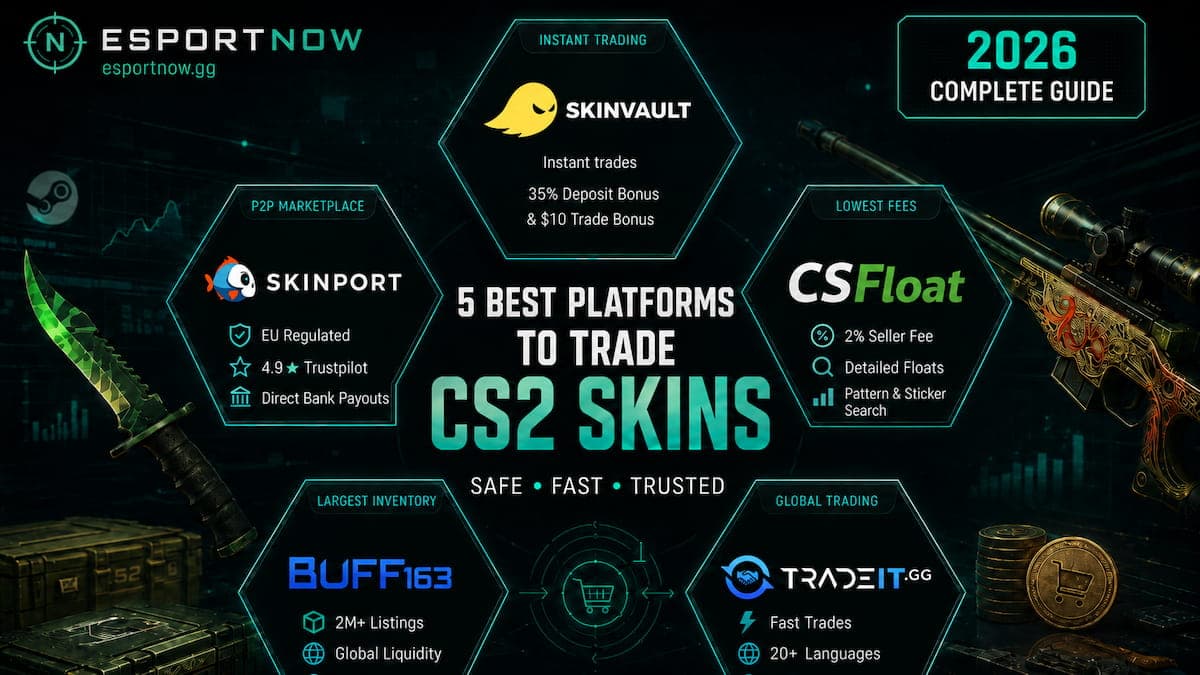
The five major CS2 skin trading platforms in 2026: Steam Market, Skinport, BUFF163, CSFloat, and Skinvault.gg compared by fees, security, and payout methods.
You want to trade CS2 skins, but you also want to keep your money and your account. Those two goals do not always line up. The CS2 skin economy now sits north of $4 billion in 2026, and the gap between traders who know what they are doing and those who do not is huge. First-timers lose 15% to Steam fees, take haircuts on bot platforms, or worse, watch their entire inventory drain overnight because of a scammer who exploited a forgotten API key.
This guide on how to trade CS2 skins safely cuts through the noise. Every fee number here is real and current as of May 2026. Every platform recommendation comes from actual reputation data, not marketing copy. Every scam method is one that has hit real traders in the last six months. By the end you will know exactly where to trade CS2 skins, what you actually take home, and how to avoid the mistakes that cost people their inventories.

The skin market has matured fast in the last two years. What used to be Wild West forum trading and risky middleman deals is now a legitimate financial ecosystem with EU-regulated marketplaces, escrow systems, and KYC compliance for high-value transactions.
However, the scammers have matured alongside it. The era of obvious phishing emails is over. In 2026 the typical attack involves stolen Steam API keys that silently redirect your legitimate trades to scammer accounts. Fake marketplaces copy real ones pixel-for-pixel. Discord bots impersonate friends with surprising sophistication. Players have lost five-figure inventories in single trades because they did not understand the API key exploit.
The real cost when you trade CS2 skins is not the listed fee. Instead, it is the difference between what you could have made on the right platform versus what you actually walk away with after fees, conversion costs, and the occasional mistake.
You have five options when you want to trade CS2 skins. Each has trade-offs, and the right choice depends on what you are trying to do.
The Steam Community Market is Valve’s built-in marketplace, integrated directly into the Steam client. Furthermore, it is the safest option in pure security terms, because nothing leaves Steam’s ecosystem.
However, the catch is the fee. Steam charges a 5% transaction fee plus a 10% CS2 game-specific fee, for a combined 15% on every sale. Moreover, that 15% is fixed with no way around it inside Steam.
The bigger issue is what happens to the money. Steam Wallet funds cannot be withdrawn to a bank account. Likewise, they cannot be sent to PayPal. Instead, they can only be spent inside Steam, which is fine if you only want to trade CS2 skins for other skins, but useless if you actually want cash.
Best for: Players who never plan to cash out and only want to swap skins.
P2P marketplaces let you list a skin at your chosen price, then wait for a buyer. When the sale closes, you get paid in real money via bank transfer, PayPal, or crypto.
Skinport, founded in 2018 in Stuttgart, runs as a German company under full EU regulatory compliance through the payment processor Adyen. Furthermore, every transaction is PSD2-compliant, which means Skinport cannot legally hold your money without a banking license. Trustpilot rates them 4.9 out of 5 from over 35,000 reviews, which is the highest in the CS2 marketplace category. The seller fee is 12% standard, dropping to 6% for high-value items.
CSFloat takes a different angle. Their seller fee is 2%, which is the lowest of any major platform. The defining feature is depth: float values, pattern indices, sticker arrangements, all filterable in detail no other marketplace matches. As a result, if you want to trade CS2 skins with specific float values, CSFloat is built for that.
BUFF163 is the biggest CS2 marketplace in the world by volume. NetEase operates it, and it carries over 2 million active listings. Seller fees are 2.5%. However, the platform is China-based, so international withdrawals are more complicated for Western users.
Best for: Anyone cashing out for real money or hunting specific patterns.
Bot trading platforms use automated systems to instantly buy or swap when you want to trade CS2 skins. You give the bot your skin, the bot gives you either another skin or site credit. Furthermore, trades complete in seconds.
Skinvault.gg launched in 2024 and has built a strong reputation in the European market, particularly across the Nordics. Based in Dubai under Virtual Skinbroker Oy, the platform now hosts around 150,000 skins with an inventory value of $26.4 million. The model is straightforward: you select skins from your inventory to give, you select skins from Skinvault’s stock to take, and the bot processes the swap instantly. Trades typically complete in under a minute.
Skinvault’s competitive edge is the 35% deposit bonus combined with low seller fees and a $10 trade bonus for new users. As a result, the math works out better than most competitors for active traders. KYC verification is required for compliance with EU regulations, but only for buying with cash deposits. Pure skin-to-skin trades skip that step entirely.
Tradeit has been operating since 2017 with over 800,000 skins in inventory. Additionally, CS.MONEY supports over 40 currencies and 20 languages, making it the most internationally flexible option in this category.
The cost on all bot platforms shows up in the spread. Bot platforms typically operate with a 5-15% gap between buy and sell prices. On a $100 skin, that means you might receive $90 in value when selling, then pay $105 to buy something similar. Indeed, that spread is the platform’s profit.
Best for: Refreshing your loadout. Similarly, swapping one skin for another without waiting for a P2P buyer.
Direct trading with another player is the original method and still works fine if you know what you are doing. The fees are zero. However, the risk is everything else.
Direct trades are the largest scam surface in the entire CS2 ecosystem. Quick-switch scams, fake middlemen, API key exploits, social engineering, all of it lives here. If you are going to trade CS2 skins through direct deals, only trade with people whose reputation you can verify.
Best for: Trades between friends and high-trust trading partners with verifiable history.
Trade-up contracts let you combine 10 skins of the same rarity into one skin of the next higher rarity. The output is randomised based on the inputs you used.
Honestly, it is more gambling than trading. The math on most trade-ups works against you. That said, some combinations are mathematically positive expectation if you know the price floors involved.
Best for: Players with stacks of cheap skins they want to gamble for something nicer.
For more on how skin value is determined before you start to trade CS2 skins seriously, our CS2 skin float value guide breaks down the technical details that affect every price.
There are over 22 third-party CS2 marketplaces operating in 2026. However, most are not worth your time. Here are the platforms that handle the overwhelming majority of legitimate trading volume.
Skinvault is the platform we recommend most often for active traders looking to trade CS2 skins efficiently. Founded in 2024 and operating from Dubai, Skinvault hosts 150,000+ skins with a total inventory value of $26.4 million according to public market trackers.
The standout feature is the 35% deposit bonus, which mathematically offsets a large portion of the typical bot trading spread. Furthermore, the $10 trade bonus for new users gives beginners real value on their first transactions. Cross-game support extends to Rust and Dota 2 items, which is useful for traders managing multi-game inventories.
Trade speed is the other selling point. Most trades complete in under a minute through Skinvault’s automated bot system. As a result, you skip the waiting game that P2P marketplaces require, although you do pay the spread for that convenience.
Trustpilot rates Skinvault 3.9 out of 5 based on customer reviews, with most positive feedback citing fast trades, helpful support (particularly through agent Leevi, who shows up in dozens of reviews), and competitive pricing. KYC verification kicks in for cash purchases due to EU regulations, but skin-to-skin trades complete without it.
You can trade CS2 skins on Skinvault directly through Steam authentication. The platform never requires sharing your API key for skin-to-skin trades, which sidesteps one of the biggest scam vectors in 2026.
Skinport’s defining trait is regulatory compliance. Operating under PSD2 rules and partnering with Adyen for payment processing means every dollar you make on Skinport goes through a fully licensed financial infrastructure. Admittedly, that sounds boring until you compare it to platforms based in offshore jurisdictions with zero legal recourse.
The 8% standard seller fee is higher than CSFloat. However, the trade-off is meaningful protection for high-value transactions. If you want to trade CS2 skins worth $2,000+, the extra fee buys you guaranteed bank transfer and EU consumer protection law on your side.
The 6% reduced rate kicks in for high-value items priced in local currency. Additionally, Skinport runs zero buyer fees, which is rare in the marketplace world.
CSFloat’s 2% seller fee is the floor for the entire industry. Furthermore, there is no platform that charges less among the legitimate options. However, the trade-off is patience: it is a true P2P marketplace, so your items sit in listings until a buyer takes them.
The technical depth is where CSFloat really separates from competitors. Every listing shows the exact float value, pattern index, and sticker positions. Moreover, you can filter for specific patterns like Tiger Tooth Phase 2 or Case Hardened blue percentages.
BUFF163 is the size leader with two million listings on any given day. Therefore, if you want to trade CS2 skins of a specific condition, the chances of finding it on BUFF163 are higher than anywhere else.
However, the big issue is geographic. BUFF163 is operated by NetEase in China, and international withdrawal methods for non-Chinese accounts are limited.
The advertised fee is not the real fee. Indeed, withdrawal costs and platform-specific quirks all add up. Here is what you actually receive when you sell a $100 skin on each major platform.

On top of seller fees, withdrawal methods add their own costs. Bank transfers are typically free or 1-2%. However, PayPal adds 3-4%. Additionally, crypto withdrawals have network fees varying by token.
Some platforms also have minimum withdrawal thresholds. Skinport requires a minimum of around $5 for bank transfers. Meanwhile, CSFloat lets you withdraw small amounts but with proportionally higher fees on tiny transactions.
The Steam Market trap deserves special attention. The 15% fee feels manageable until you realise the funds are locked in Steam forever. For example, if you sell a $1,000 skin on the Steam Market, you have $850 in Steam Wallet credit. That is not $850 in your bank account. Furthermore, if you flip the same skin three times on Steam, you have lost 38.5% of the original value before you keep anything outside Steam.
Every scam below has cost real traders real money in the last six months. Knowing them is your first line of defence.
This is the most dangerous attack in CS2 trading right now. You log into a fake site at some point in the past. The site quietly extracts your Steam API key. Weeks later, when you try a legitimate trade, the scammer’s bot detects it, cancels your offer, and sends an identical-looking offer from a scammer account. You confirm without re-checking. Then your skins are gone.
How to check: Go to steamcommunity.com/dev/apikey. If you see an API key listed that you did not personally create, revoke it immediately and change your password.
How to prevent: Never share your API key. Use platforms that work through Steam’s official OpenID login.
Scammers buy Google Ads for terms like “Skinport login” or “CSFloat marketplace”. The ad goes to a fake site that looks identical to the real one. You enter your Steam credentials. Then the fake site captures your session.
Common phishing tricks include letter substitution (“steamcornmunity” with rn instead of m), homoglyph attacks using Cyrillic characters, and subdomain confusion.
How to prevent: Never click search engine ads for trading sites. Bookmark the real URLs and type them manually.
This one is new in 2026. Scammers post fake QR codes claiming to be Steam authenticator setup or marketplace login. You scan the code. As a result, the code links your authenticator to the scammer’s account.
How to prevent: Never scan QR codes from random sources. Steam’s authenticator setup happens inside the Steam Mobile app.
Someone proposes a high-value trade and suggests using a “middleman” for safety. The middleman is in on it. Your items disappear.
How to prevent: Real trades do not need middlemen. Instead, use a P2P marketplace where the platform handles escrow.
You are in a Steam trade window. At the very last second, the scammer swaps in a similar-looking but worthless skin. You confirm without re-checking.
How to prevent: Always re-check trade contents on the final confirmation screen. Look at actual skin names, not just icons.
You see an ad for a new “high-rate cashout site” offering 105% of market value. You deposit a skin. The site shows credit going up. However, withdrawal is delayed for “verification” indefinitely.
How to prevent: Only use marketplaces with verified Trustpilot ratings of 4.0+ and at least 1,000 reviews.
Scammers join trading Discord servers and DM you with a “great deal” or urgency tactics. The whole thing is a setup.
How to prevent: Never trust someone just because they are in a trading Discord. Verify identity through multiple channels.
This catches new traders constantly. Your Steam Guard Mobile Authenticator must have been active on your account for at least 15 days before you can make full instant trades. Before that, any trade has a 15-day holding period.
Scammers exploit this by tricking newer accounts into trades they think are completing immediately. The held items show as locked for 15 days, but the scammer claims they will release them “after verification”. However, they never do.
The fix: Activate Steam Guard immediately. Then wait the full 15 days before doing serious trading. Any deal that involves working around the 15-day rule is almost certainly a scam.
Different traders need different platforms. Here is how to choose.
Use Skinvault.gg. The 35% deposit bonus plus the $10 starter bonus give active traders real value that compounds over many trades. Furthermore, the instant bot trading means no waiting for P2P buyers.
Use Skinport. The fee is higher than CSFloat, but the EU regulatory protection and direct bank transfer are worth the cost on a single high-value sale.
Stick with CSFloat. Truly, no other platform comes close on technical depth. Pattern hunters and float collectors live on CSFloat almost exclusively.
Choose BUFF163. The deepest inventory and most accessible payment infrastructure for the region.
Start with Steam Market for your first three or four sales just to understand the mechanics. Then move to a trusted third-party platform like Skinvault or Skinport once you are comfortable.
For specific guidance on which skins are worth trading, our top 10 CS2 knife skins guide covers the knives most worth your money in 2026.
If you have never traded a CS2 skin before, this is how to start.
Activate Steam Guard Mobile Authenticator. Set a unique password. Additionally, enable email confirmations for all logins.
Do nothing serious until Steam Guard has been active for at least 15 days. Meanwhile, use this time to learn the platforms.
Pick a skin worth $5-20. List it on the Steam Community Market. Watch how the process works and get familiar with the interface.
A Factory New version of the same skin can be worth ten times more than a Battle-Scarred version. Therefore, if you do not understand wear, you will lose money. Our CS2 skin wear levels guide explains the five conditions and their price implications.
Pick a trusted platform like Skinvault for instant trades or Skinport for cashing out. The interface on both is approachable. List one mid-value skin and go through the entire workflow.
Only after 5-10 successful trades should you move high-value items through any platform. Each platform has quirks worth learning on small trades first.
Once you understand the major platforms, use multiple. Specifically, Skinvault for active trading, Skinport for high-value sales, CSFloat for technical purchases.
Three things are shaping the rest of the year for anyone who wants to trade CS2 skins.
The IEM Cologne 2026 Major in June will drive a massive spike in sticker demand. Historically, Major stickers see 300-500% appreciation in the months following the event. Therefore, anyone holding skins they could apply Cologne stickers to should consider timing.
Valve has not signaled changes to the 15% Steam Market fee for 2026. As a result, third-party platforms will continue to grow share at Steam’s expense.
Case releases drive massive volume across every platform and typically create arbitrage opportunities between Steam Market and third-party sites for 48-72 hours after launch. Consequently, active traders should watch for the next case release announcement.
For ongoing tracking of skin prices and market trends, our CS2 skin market update covers the biggest movers each month.
If you only read this far, here is what matters when you trade CS2 skins.
Steam Market is safe but expensive (15% fee, money locked in Steam Wallet). Use it for first sales only.
Skinvault.gg is the best instant-trade platform with the 35% deposit bonus making the math work for active traders.
Skinport is the best off-ramp for real money in the EU and North America with full Adyen-backed regulatory compliance.
CSFloat has the lowest fees in the industry (2%) and is the best platform for collectors hunting specific floats or patterns.
BUFF163 has the biggest inventory globally, but withdrawal complications outside China limit it for Western users.
The seven main scam types in 2026 are API key exploits, phishing sites, QR code hijacking, fake middlemen, quick-switch trades, fake marketplaces, and Discord social engineering.
Activate Steam Guard immediately. Wait 15 days before serious trading. Never share your API key. Bookmark real URLs and never click ads for trading sites.
The CS2 skin market in 2026 is the safest it has ever been, but only if you stay on the legitimate platforms. Pick the right one for your style, learn the scams to avoid, and you will keep almost all of what you make when you trade CS2 skins.
For more guides on CS2 skins, see our growing collection at the EsportNow CS2 skins hub.
CS2Here’s everything Counter-Strike players should know about the new Chicken Pets, including how to get them and all available colors.
 CS2
CS2Here’s everything CS2 esports fans should know about fl0m’s iBUYPOWER Masters FML 2026, including its teams, format, and how to watch.
 CS2
CS2Valve has reportedly shut down a CS2 skinchanger website, serving a legal cease-and-desist. What does this mean for Counter-Strike?